
Phone
9874 7684
-
 By: Tony
- Comments Off on BMW Timing Chain Problems: Warning Signs & Repair Costs
 By:
BMW Timing Chain Problems: Warning Signs & Repair Costs
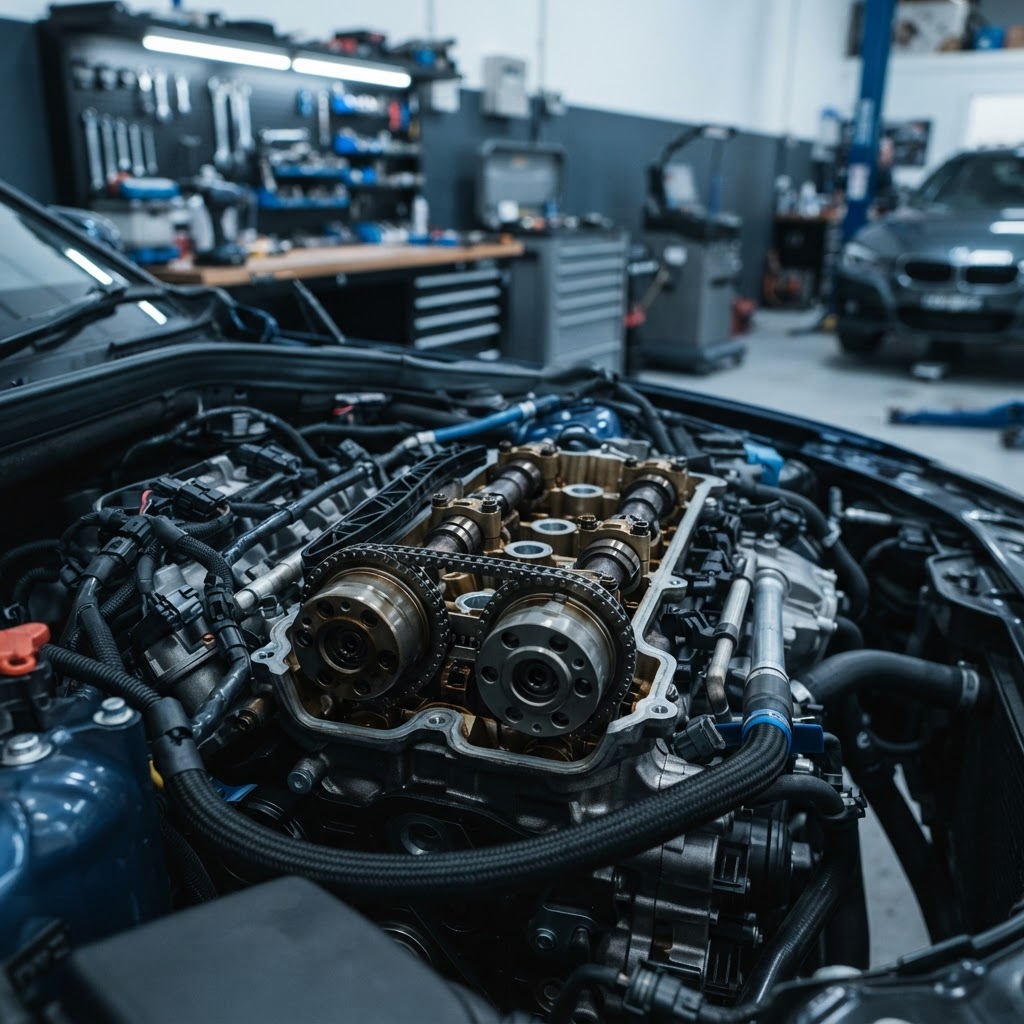
Quick Answer: BMW timing-chain problems can show up as a cold-start rattle, rough running, difficult starting, a warning light or timing-related fault codes. The noise is not a diagnosis on its own: VANOS, the auxiliary belt, an accessory or normal injector noise can sound similar. At West Ryde Service Centre, we diagnose BMW timing concerns in West Ryde and across Sydney by combining scan data with mechanical inspection, then provide a written repair scope based on the exact model and engine.
A timing chain is one of those parts most BMW owners hope they never have to think about. It is inside the engine, it is not a simple service item like an oil filter, and a problem can become expensive if the chain jumps or breaks. The good news is that a noise does not automatically mean the engine is about to fail. The important thing is to identify what you are hearing and get the right checks done before guessing at parts.
Below I’ll explain the warning signs, the BMW engines and systems that need careful diagnosis, what happens in the workshop, and how to approach a repair quote in Sydney. If you are hearing a new rattle, especially on a cold start, do not keep revving the engine to reproduce it. Note when it happens and arrange an inspection.
Common Symptoms of a BMW Timing Chain Problem
Timing-chain faults can develop gradually or appear alongside other engine symptoms. These signs are worth taking seriously, but they still need confirmation:
- Rattle on cold start: a brief metallic rattle at start-up may relate to chain slack, a tensioner or guide. It can also come from another component, so the duration and location matter.
- Rough running or difficult starting: if valve timing is no longer where the engine expects it to be, the engine may crank for longer, misfire or idle poorly.
- Engine warning light: timing correlation faults may be stored, although the same light can be triggered by sensors, VANOS faults, ignition issues or other problems.
- Whining, scraping or grinding: a change in engine noise deserves attention, particularly if it changes with engine speed.
- Stalling or loss of power: these symptoms need prompt assessment. Stop driving and seek advice if they are severe or arrive with a loud mechanical noise.
Sound alone cannot tell you whether the timing chain is at fault. A phone recording can help a technician understand the complaint, but it is not a substitute for checking the vehicle.
Possible Causes and BMW-Specific Considerations
Chain, guides and tensioner
The chain runs over guides and is controlled by a tensioner. Wear, damaged guide material or loss of tension can create slack and noise. The correct inspection depends on the BMW engine and its service information.
VANOS or timing control
Variable camshaft timing faults can produce rough running, warning lights and noises that owners may describe as timing-chain trouble. Scan data and mechanical checks help separate the systems.
Auxiliary drive or accessories
An idler, tensioner, alternator, water pump or auxiliary belt can make a rattle or whine from the front of the engine. Replacing a timing chain without ruling these out is the wrong approach.
Oil and maintenance history
Oil level, oil condition and the vehicle’s maintenance history are relevant to diagnosis. Always follow the owner’s handbook for checking oil and use the correct vehicle-specific information.
BMW discussions often focus on the N20 and N26 four-cylinder engines, and owners also ask about B48 and B58 engines. Those labels are useful starting points, not a diagnosis. Production date, market, exact model, engine variant, software, service history and VIN can all change what applies. A technical bulletin found online is not proof that a particular Australian BMW qualifies for a repair programme.
If you own an affected-generation BMW, check the VIN through BMW Australia’s recall and technical-campaign portal. That is the sensible way to check for an applicable campaign. Do not assume that a result for another country, engine or production range applies to your car.
How the Problem Is Diagnosed
We take the symptom history
We ask whether the noise is cold-start only, whether it changes with engine speed, whether the car has stalled, and whether there are warning lights or recent repairs. Bring the VIN, registration details and service history if you have them.
We confirm the complaint safely
A controlled start and road test can help reproduce the symptom. We listen for where the noise is coming from and compare it with normal operating sounds. We do not treat a video or a customer description as a final diagnosis.
We scan and inspect
BMW-capable scan data is interpreted alongside a visual and mechanical inspection. We check relevant fault codes, timing correlation information, oil condition and accessible components, while also ruling out VANOS, belt-drive, injector, exhaust and drivetrain noises.
We confirm the repair scope
Before quoting, we identify the failed component as far as the inspection allows. A chain job may involve a chain kit, guides, tensioner, seals and related labour, but the exact scope depends on the engine and what the inspection finds.
For example, with a B58 340i, our diagnostic approach is not to hear one rattle and immediately order a chain. We first separate timing-control noise from the accessory drive, VANOS operation and the normal mechanical sounds produced by direct injection. That model-specific thinking is important: a B48, N20, N26 and B58 do not share one universal failure pattern or one universal repair procedure.
What Happens If You Ignore It?
Important: A mild noise does not prove imminent engine failure, but a loud or worsening rattle combined with a warning light, difficult starting, stalling, loss of power, severe rough running or visible damage should not be treated as a “drive it and see” problem. Switch the engine off when safe and arrange professional advice.
If valve timing moves far enough out of position, the engine can run badly and, in some circumstances, internal components can contact each other. That is why early diagnosis is worthwhile. It is also why continuing to drive a car with a serious mechanical noise can turn a component repair into a much larger engine repair. A technician needs to establish the actual condition rather than predict the outcome from the sound alone.
How Much Does BMW Timing Chain Replacement Cost in Sydney?
There is no honest single BMW timing-chain price. An indicative third-party Australian reference places some BMW timing-chain replacement work around $1,200–$2,000, but that is not a West Ryde Service Centre quote and it will not suit every model. Parts choice, access, chain kit contents, guides and tensioners, seals, diagnosis, labour and any consequential damage can change the result substantially.
Ask for a written quote that separates the diagnostic work, parts, labour and any additional repairs. Ask whether the chain, guides and tensioner are included, whether seals or fluids are required, and what happens if inspection reveals related damage. NSW Fair Trading’s vehicle-repair guidance is also useful background when comparing quotes and understanding repair discussions.
Do not accept a fixed price based only on a generic internet article. The exact BMW model, engine code, VIN and the confirmed fault should be on the job record.
How West Ryde Service Centre Can Help
We work on BMW servicing and mechanical repairs at 1135 Victoria Rd, West Ryde NSW 2114. That gives us a practical local starting point for drivers coming from Ryde, North Ryde, Meadowbank, Eastwood and nearby Sydney suburbs. Our phone number is (02) 9874 7684.
Our job is to diagnose the fault before recommending a repair. That can mean confirming that a timing chain really is involved, or finding that the noise is coming from an accessory, VANOS component, injector or another part. You can read more about our BMW service in Sydney or our broader European car repairs approach.
Relevant BMW Expertise
BMW owners may be asking about an N20 or N26 four-cylinder, a B48 four-cylinder, or a B58 six-cylinder in a 3 Series, 4 Series, 5 Series, X1, X3 or another model. The model name alone is not enough. We need to work from the vehicle identification, engine details and symptoms before applying technical information.
That is also why “BMW timing chain replacement interval” is a risky search question. There is no universal mileage figure I can responsibly give every BMW. Follow the vehicle-specific maintenance information, keep oil and service records, and investigate new symptoms rather than waiting for an internet mileage rule.
For related warning signs, see our article on European car problems that need prompt attention. If you also own an Audi, our guide to common Audi A4 problems shows why manufacturer and engine context matters.
Local Context for Sydney BMW Owners
Short trips around Victoria Road, stop-start traffic near Ryde and regular motorway use on the M2 all place different demands on a car, but they do not diagnose a timing-chain fault. A cold-start rattle in a West Ryde driveway may be easier to hear than the same noise on a busy road. If you can safely record when it occurs, note the outside temperature, whether the engine was cold, and whether the warning light appeared.
If the car is running roughly or losing power on the way to us, do not take a risk in traffic. Contact the workshop and ask about the safest next step.
Related Services & Articles
- Mechanical repairs and car servicing
- Car advice and maintenance guides
- Contact West Ryde Service Centre
Frequently Asked Questions
What are the warning signs of a BMW timing-chain problem?
Possible signs include cold-start rattle, unusual grinding or whining, difficult starting, rough running, warning lights and timing-related fault codes. These symptoms can also come from other engine systems, so inspection is required.
Does a BMW timing chain need replacing at a set mileage?
There is no universal replacement mileage that applies to every BMW engine. Use the vehicle-specific maintenance information and have new noise or running issues diagnosed.
Can I drive a BMW with timing-chain rattle?
Do not keep driving if the rattle is loud or worsening, or if it comes with a warning light, stalling, loss of power or severe rough running. Stop when safe and arrange professional advice.
How much does BMW timing-chain replacement cost in Sydney?
An indicative third-party Australian range is around $1,200–$2,000 for some BMW work, not a WRSC quote. The actual price depends on the model, engine, parts, access, labour and any related damage.
Which BMW engines are associated with timing-chain concerns?
Owners commonly ask about N20, N26, B48 and B58 engines, but an engine family name does not prove a fault or campaign applies. The exact model, production details and VIN need to be checked.
Can VANOS sound like a timing-chain problem?
Yes, VANOS and other components can create similar noises or running symptoms. Scan data must be interpreted with a mechanical inspection and a check of the accessory drive.
What should I bring for a BMW timing-chain inspection?
Bring the VIN or registration details, service history, a description or recording of the noise, and information about warning lights, recent work and when the symptom occurs.
Can a timing-chain problem damage the engine?
If valve timing moves significantly out of position, serious internal damage can occur in some circumstances. That does not mean every rattle will cause damage, which is why accurate diagnosis matters.
Need Expert Car Servicing in Sydney?
West Ryde Service Centre has been Sydney's trusted European and hybrid car specialist since 1981. Book your service today.
Book a Service Call (02) 9874 7684
Related Post

BMW N52 Engine Common Problems: Valve Cover Gasket, Water Pump..
If you own a BMW built between roughly 2004 and 2015 with a naturally aspirated..

BMW B58 Engine Guide: Tuning Potential and Common Issues
BMW B58 Engine Guide: Tuning Potential and Common Issues Quick Answer: The BMW B58 is..