
Phone
9874 7684
-
 By: Tony
- Comments Off on DSG Service Intervals: How Often Should You Change the Oil?
 By:

If you own a Volkswagen Group car with a DSG gearbox, the service schedule is one of the few maintenance items that genuinely saves you thousands if you keep on top of it. The catch is that the answer to “how often” depends on which DSG you have, and most of the information online is written in miles for American and British readers, which confuses more than it helps. Here is the Australian, kilometre-based answer from our workshop on Victoria Road.
Quick Answer: Wet-clutch DSG gearboxes (the 6-speed DQ250 and 7-speed DQ381/DQ500) need a fluid and filter change roughly every 60,000 km or 4 years, whichever comes first. The 7-speed dry-clutch DQ200 has no factory schedule, but specialists including us at West Ryde Service Centre generally recommend inspecting and changing its two small fluid volumes around every 80,000 to 100,000 km. If your Golf, Polo, Tiguan, Passat or Amarok does mostly Sydney stop-start driving, treat those as ceilings rather than targets.
Common Symptoms of an Overdue DSG Service
DSG oil is doing two jobs at once. It lubricates the gear sets, and it is the hydraulic medium that actuates the clutches and drives the mechatronic unit. When it degrades, you feel it long before anything shows a warning light. The symptoms we see most often in the workshop:
- Shudder at take-off: a vibration through the car as you pull away from lights, most noticeable between 1,500 and 2,500 rpm in stop-start traffic.
- Harsher, snappier shifts: the gearbox that used to be seamless now thuds between gears, especially first to second and second to third.
- Clunky engagement: a delay or a clunk when you move the lever from P to D or reverse.
- Occasional flare or double-bump: the revs rise, then the clutch grabs in two stages.
- Gearbox pressure or transmission warning: by this stage the fluid has usually been past its best for a long while.
One important note: these are also the early symptoms of mechatronic and clutch pack faults, which are different jobs. We have written a full guide to DSG mechatronic problems and repairs separately. If you are chasing a diagnosis rather than a maintenance schedule, start there.
Possible Causes: Why DSG Oil Degrades
Heat cycles
Every clutch engagement heats the fluid. Sydney summer traffic on Victoria Road or the M2 pushes fluid temperatures well past what a European motorway cruise ever will, and heat breaks the oil down faster.
Stop-start clutch slip
The duty cycle DSGs hate most is exactly what a North West Sydney commute is: crawling queues, hill holds, thousands of take-offs a week. More slip means more heat and more contamination.
Wear particles
As clutches and synchros wear, metallic particles and clutch friction material end up suspended in the oil, where they circulate through the mechatronic valves and solenoids.
Time, not just kilometres
DSG fluid absorbs moisture and loses its additive package sitting still. That is why Volkswagen specifies a four-year limit alongside the distance. A 2018 Golf with 40,000 km is overdue on time alone.
Which DSG Gearbox Do You Have?
The interval depends entirely on the gearbox family, so the first thing we do is confirm the gearbox code from the build plate, the service book, or by running your VIN. The common units in Australian-delivered cars:
| Gearbox | Type | Common cars | Recommended interval |
|---|---|---|---|
| DQ250 (6-speed) | Wet clutch | Golf GTI Mk5/6/7, Tiguan, Passat, Amarok, some Audis | 60,000 km or 4 years |
| DQ381 (7-speed) | Wet clutch | Golf Mk7.5/8, Tiguan, Passat B8, Amarok | 60,000 km or 4 years |
| DQ500 (7-speed) | Wet clutch | Tiguan 162TSI, Golf R, Amarok V6, Transporter | 60,000 km or 4 years |
| DQ200 (7-speed) | Dry clutch | Golf, Polo, Octavia, A3 (smaller engines) | No factory schedule; specialist inspection/change around 80,000 to 100,000 km |
Ignore the US and UK forums quoting 40,000 or 80,000 miles. For Australian-delivered cars, the wet-clutch answer in kilometres is 60,000 km or four years. The DQ200 is the odd one out: Volkswagen’s official position is that it is sealed for life, and their Australian service schedules publish no fluid-change interval for it. In practice, the DQ200 has two separate small oil circuits, roughly 1.7 litres on the mechanical side and about 1 litre for the mechatronic hydraulics, and Australian specialists widely recommend inspecting and renewing both around the 80,000 to 100,000 km mark, earlier if the car lives in traffic.
How the Problem is Diagnosed
Because DSG symptoms overlap between tired fluid and genuine hardware faults, a proper service always starts with checking rather than guessing:
Confirm the gearbox by VIN
We identify the exact gearbox family from your VIN before anything else. The interval, the fluid spec and whether a filter is fitted all depend on it. Guessing here is how DQ200s get sold services they do not need, and DQ250s miss ones they do.
Scan and read live data
Factory-level diagnostics (we use ODIS-level tooling) reads clutch adaptation values, mechatronic pressure data and any stored fault codes. Adaptation values that keep climbing are a classic sign the fluid is past its best.
Check the fluid itself
Fluid condition tells us a lot on the bench. Dark, burnt-smelling oil with visible particles means the gearbox has been running hot; glitter in the pan points at hardware wear rather than just an overdue service.
Renew properly, not just a drain and fill
The replacement fluid is set at a controlled temperature (around 35 to 45 °C) with the gearbox in a defined fill position, and the clutch and adaptation values are reset afterwards. Without the temperature level-set and the adaptation reset, the new oil can actually shift worse than the old.
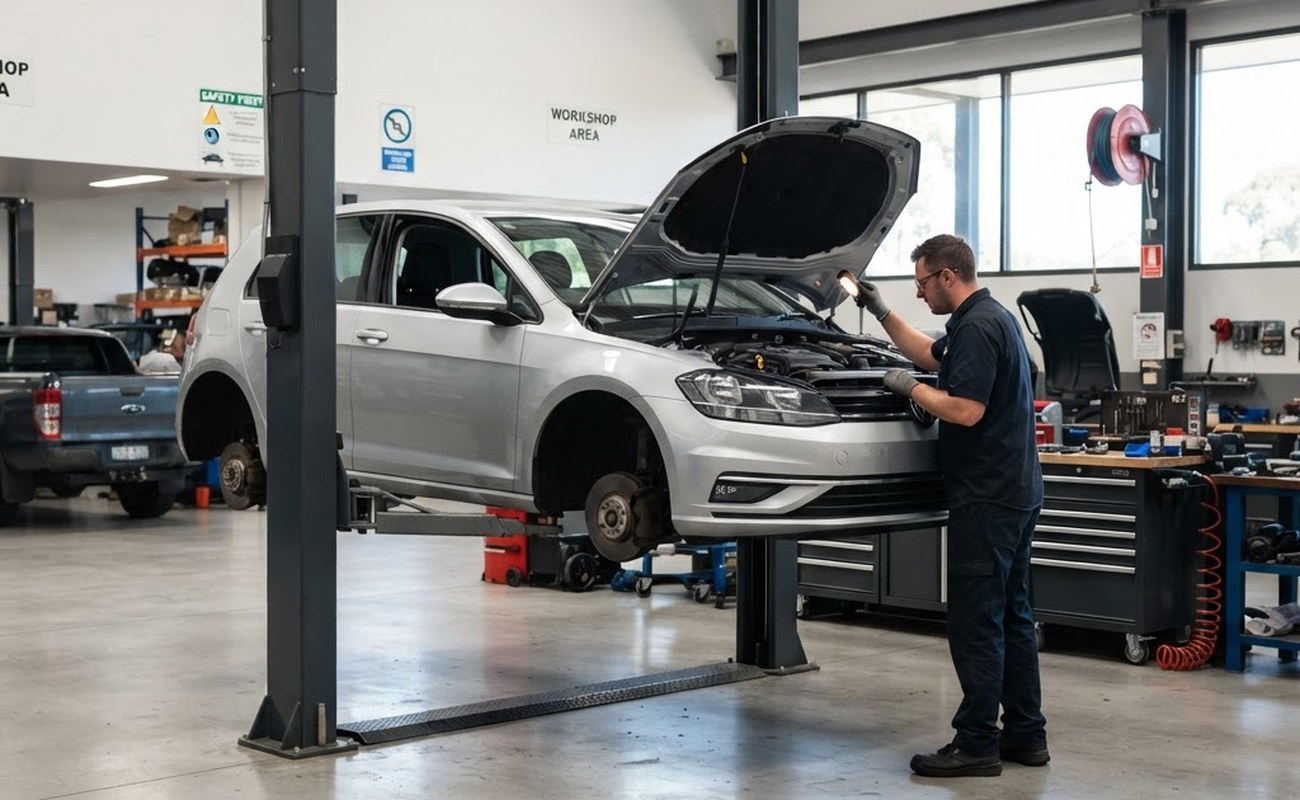
A recent one from the hoist: a 2016 Tiguan 162TSI in from Epping with take-off shudder the owner had been told was “just how DSGs are”. It had done 68,000 km with no DSG service in the book. The ODIS scan showed clutch adaptation values running near their limit, and the fluid came out dark and burnt-smelling. Fresh fluid and filter, a proper temperature level-set and an adaptation reset had it pulling away clean by the afternoon, and it was still shifting beautifully at its logbook service six months later.
What Happens If You Ignore It
Do not defer this one. Degraded DSG fluid slowly wears the mechatronic unit, the hydraulic control module with its solenoids and sensors. Once that is damaged, you are no longer paying for a few hundred dollars of preventive maintenance. Mechatronic repairs and replacements are routinely quoted in the multiple thousands of dollars in Australia, with owner-reported figures ranging from around $2,000 to over $7,500 depending on the unit and the repair. A shudder that would have been fixed with a service becomes a shudder plus a solenoid, then a gearbox out of the car.
It is a similar story with the clutches. Contaminated, overheated oil accelerates clutch pack wear, and shudder that starts as a fluid problem becomes a clutch replacement job. Of every DSG failure we see on the hoist, the ones that skipped the 60,000 km service are over-represented.
How West Ryde Service Centre Can Help
We have been looking after VW Group dual-clutch gearboxes as an independent workshop on Victoria Road since 1981: DQ200 dry-clutch units, DQ250s, and DQ381s, including mechatronic work. A DSG service with us includes the correct-spec genuine or OEM-equivalent fluid, the filter where the gearbox design has one, the temperature-controlled level-set, and a full adaptation reset with factory-level diagnostics so the gearbox relearns its clutch engagement points on fresh oil. We service to manufacturer specification, which under the ACCC’s consumer guarantees means your new-car warranty is not voided by using an independent workshop instead of a dealer. Genuine or equivalent-quality parts, fitted to spec, is what the law asks for. If you want the whole debate laid out, we have written about independent specialists versus dealerships separately.
As for cost: specialist workshops commonly quote in the $300 to $550 range for a wet-clutch DSG fluid and filter service, and DQ200 fluid work is typically a little cheaper given the smaller volumes. Parts-industry indicative pricing puts the mechanical side around $250 to $450 and the mechatronic hydraulic service around $300 to $550. Owners commonly report paying more at dealerships. Rather than guess at what your specific gearbox needs, call us on (02) 9874 7684 and we will confirm your gearbox from the VIN and give you a firm quote.
VW Group Expertise: Models We See Every Week
DSG gearboxes are not just a Volkswagen thing. The same families are spread across the group, and on any given week our hoists carry Golf 7s and 8s, Polos, Tiguans, Passats and Amaroks, plus Audi A3s and Q3s wearing the same gearboxes with S tronic badges. If your car is showing the VW EPC warning light alongside shift problems, that combination often points at the mechatronic side and is worth checking before anything else. Owners of the Golf specifically may also find our VW Golf common problems guide useful for the broader picture, and Audi owners can read our guide to Audi S tronic and transmission warning signs.
For the full picture on VW service in Sydney, the DSG work sits alongside routine logbook servicing.
Local Context: Sydney Traffic Is the Hard Case
Here is the honest local truth: Sydney’s North West is close to a worst-case duty cycle for a DSG. The Victoria Road crawl through Gladesville and Drummoyne, the Lane Cove Tunnel queues, stop-start M2 runs to Macquarie Park. That is thousands of clutch engagements a week with precious little airflow through the gearbox’s cooling. Plenty of our Gladesville customers and commuters from Ryde, Epping and Parramatta arrive with exactly the low-speed shudder this driving pattern produces. If that is your daily run, we tend to steer people toward the earlier end of every interval, and on a DQ200 we would rather look at the fluid at 80,000 km than wait for symptoms at 120,000.
Related Services & Articles
- Mechanical repairs and car servicing
- Gearbox and transmission repairs, including dual-clutch, automatic and manual work
- DSG mechatronic problems, the symptoms-and-repair companion to this guide
Frequently Asked Questions
How often should a DSG gearbox be serviced?
For wet-clutch units (the 6-speed DQ250 and 7-speed DQ381/DQ500), every 60,000 km or 4 years, whichever comes first. For the dry-clutch DQ200, there is no factory interval, but most Australian specialists recommend inspecting and changing the fluid around every 80,000 to 100,000 km.
Does the 7-speed DSG (DQ200) need an oil change?
Volkswagen treats it as sealed for life, so there is no scheduled change. In practice the gearbox has two small oil circuits, and degraded oil in the mechatronic side is a known contributor to the unit’s shift problems, so specialists, including us, recommend renewing both volumes around the 80,000 to 100,000 km mark.
How much does a DSG service cost in Sydney?
Specialist workshops commonly charge around $300 to $550 for a wet-clutch fluid and filter service. DQ200 fluid work is indicative of a little less given the smaller volumes. Dealers are generally dearer, based on what owners report. We confirm your gearbox from the VIN and quote before any work starts.
Can I service my DSG outside the dealership without losing my warranty?
Yes. Under the ACCC consumer guarantees, your manufacturer’s warranty is not voided by using a qualified independent workshop, provided the service uses genuine or equivalent-quality parts and follows the manufacturer’s specification.
What are the signs a DSG service is overdue?
Take-off shudder, harsher shifts, clunky engagement from park, and double-bump shifts are the classic early signs. If a transmission or gearbox pressure warning has appeared, the fluid has been past its best for a while and the car should be checked promptly.
Is 60,000 km too long in Australian conditions?
It is a maximum, not a target. If your car spends its life in Sydney stop-start traffic (Victoria Road, the M2, school runs), the fluid works much harder than the schedule assumes. Many owners and specialists bring the service forward, and we are happy to advise for your specific driving pattern.
What’s the difference between wet-clutch and dry-clutch DSG service?
Wet-clutch gearboxes (DQ250, DQ381, DQ500) submerge the clutches in cooling oil, so they carry more fluid, have a factory interval and usually a filter. The dry-clutch DQ200 keeps its clutches dry and uses two small separate oil volumes, one for the gears and one for the mechatronic hydraulics, with no factory schedule.
How long does a DSG service take?
Allow roughly half a day with us. The fluid and filter change itself is not long, but the temperature-controlled level-set, the adaptation resets and a road test to confirm the shift quality properly take the balance of the morning. Call (02) 9874 7684 and we will book a slot that suits you.
Need Expert Car Servicing in Sydney?
West Ryde Service Centre has been Sydney's trusted European and hybrid car specialist since 1981. Book your service today.
Book a Service Call (02) 9874 7684
Related Post
VW Golf Common Problems: A Mechanic’s Guide
Quick Answer: The most common VW Golf problems we see at West Ryde Service Centre..

VW Golf R EA888 Engine: Tuning Stages and Reliability Guide
Quick Answer: The EA888 Gen 3 in the VW Golf R is one of the..