
Phone
9874 7684
-
 By: Tony
- Comments Off on Warped Brake Rotors: Symptoms, Causes & Replacement Cost
 By:
Quick Answer: A brake pedal that throbs or a steering wheel that shudders when you brake from speed is usually disc thickness variation on your brake rotors, the thing most of us shorthand as “warped rotors”. At West Ryde Service Centre on Victoria Road we measure rotors before we quote: machined where the disc has life left in it, replaced where it doesn’t. We handle BMW, Mercedes-Benz, Audi, VW and other European brakes every day, and we’ve been doing it in Sydney since 1981.
Every week a car rolls into the workshop with the same story: the steering wheel shakes when the brakes go on, a mechanic somewhere said the rotors are “warped”, and the quote is for four new discs. Sometimes that quote is spot on. Often it isn’t, and the fix costs a fraction of it.
Here’s the part most people miss. Brake rotors almost never actually bend. The pulsation everyone calls “warped” is usually disc thickness variation, or DTV: pad material baked unevenly onto the disc face, or a disc sitting slightly out of true and wearing unevenly. Either way there are thick and thin spots measured in hundredths of a millimetre, and your foot feels every one through the pedal. MotorTrend and brake manufacturer Alcon have both written whole pieces on the warped rotor myth; it matches what our dial indicator shows every week.
Why does the difference matter to your wallet? Because a disc with uneven material transfer can often be trued up. A bent disc can’t be, but you very rarely meet one. We had a 2014 F30 328i in from Epping last month that had been wheel-balanced twice at two different tyre shops because the owner was sure the shake at 100 km/h was a balance problem. On the road test the clue was there straight away: the throb came through the pedal, not the seat, and only while braking. Five minutes on the hoist with a micrometer found thickness variation on both front discs. Those two balances never stood a chance, because it was never balance.
So let’s sort the real thing from the imitations, work out what causes it, and get to what fixing it should cost in Sydney.
Common Symptoms
The signs of a rotor with thickness variation are consistent across most European cars we see:
- A throbbing or pulsing brake pedal under firm braking, like a slow, dull ABS cycle
- Steering wheel shudder when braking from highway speed, usually strongest from around 100 km/h down
- A judder you feel through the whole car under a hard stop, which often points to the rear axle
- Longer stopping distances, or a brake that gets worse the more you use it on a long descent
- Squealing or scraping from one wheel, especially soon after the car has been sitting
- Visible scoring, blue heat spots, or a raised rust ridge at the disc’s outer edge through the wheel spokes
- A hot, acrid smell after heavy braking or a long hill
Plenty of things imitate rotors, and timing gives them away. Shake at a steady speed with your foot off the brake is wheel balance, a bent rim or bushes, a split we cover in our steering wheel vibration guide. A grinding smell with a hot wheel points to a seized calliper, covered in our soft brake pedal guide. A squeal with no pedal pulsation is usually pads, which we break down in squeaking brakes and when to worry.
Possible Causes
On the European cars that come through our doors, six causes account for nearly all rotor pulsation. Each one points to a slightly different fix.
Heat and uneven pad transfer
The big one. When discs run hot, pad material transfers onto the disc face. Land it unevenly, which is what happens after a hard stop with the pads clamped on hot discs, and you get thick and thin patches the calliper finds every revolution.
Over-torqued wheels and runout
A disc clamped even slightly out of true wears unevenly, and rattle-gunned lug nuts are the classic culprit. A Golf came to us pulsating a week after a tyre shop zipped all four wheels on with a gun. Re-torqued to spec in a star pattern, discs trued, pulse gone.
A seized or dragging calliper
One dragging corner keeps its disc hot, cooks a pad imprint into the face and glazes everything it touches. Torn slide-pin boots and never-serviced pins sit behind plenty of “warped rotor” diagnoses.
Corrosion and sitting
Cars that sit, especially near salt water, grow pitting and a rust ridge at the disc’s outer edge. Once the ridge stands proud of the swept face, the pads ride over it and the pedal complains. Short-trip cars near the river are repeat offenders.
Discs near their minimum
Every rotor carries a minimum thickness stamped or cast into the hat. A disc already near that mark after a past machining usually can’t be trued again, and pushing on just thins it past the limit.
Heavy use
Towing, a loaded seven-seater, repeated hard stops in traffic or a long descent all push heat past what standard pads and discs can shed. Hot spots follow, then pulsation, then cracks if you keep going.
How the Problem is Diagnosed
We don’t sell discs on a guess, and any workshop that quotes four new ones before measuring is having a lend of you. Here’s our sequence:
Road test first. When the shake appears tells most of the story: braking-only pulse points at the discs, steady-speed shake at wheels and suspension, bumps at bushes and joints. Ten minutes on the road narrows the list before the car goes on the hoist.
Wheels off, everything inspected. Pads, pad wear sensors and their wiring, callipers, slide pins and boots, plus a close look at the disc faces for scoring, blue heat spotting, rust ridges and cracks.
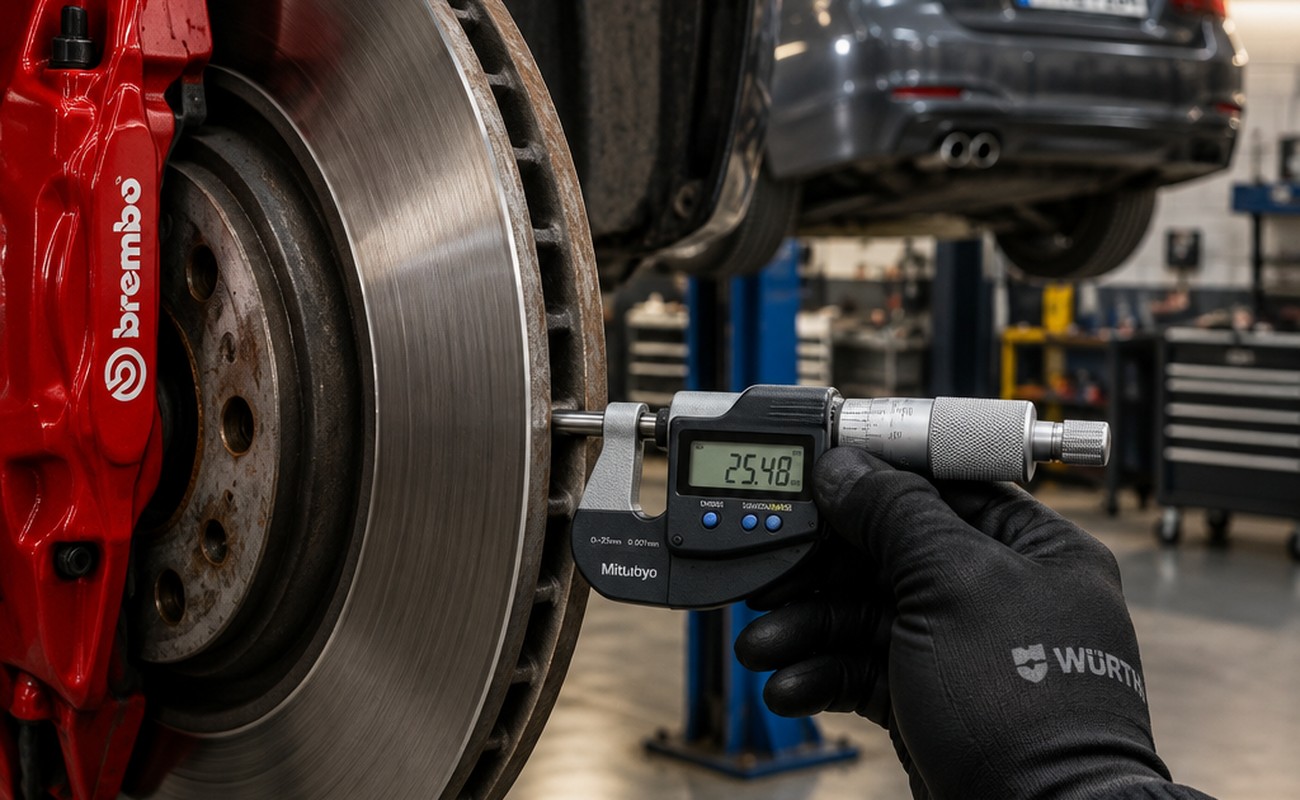
Thickness measured at eight points. A micrometer at eight spots, front and back, compared against the minimum stamped into the rotor’s hub face. Variations smaller than a human hair are what your pedal has been feeling. Below the stamped number, machining is off the table.
Runout checked with a dial indicator. If the disc wobbles as it spins, we check for corrosion or debris trapped between the rotor hat and the hub, a common find on cars that have had quick tyre work.
A verdict, in plain English. Three honest outcomes: machine the discs, replace them, or “it isn’t the rotors”. We machined both front discs on a Golf GTI last spring and saved the owner roughly half the cost of new discs and pads. Two weeks later we had a W205 C-Class whose front rotors were already below their stamped minimum from a machining in a previous life. Both got the right answer, not the expensive default.
What Happens If You Ignore It
It won’t fix itself, and it gets dearer as it goes. A pulsating system hammers the pads unevenly so they wear in a wedge, and the callipers, slides and even wheel bearings cop the vibration. Hot spots can crack, turning a machining job into a replacement. In NSW, brakes must be effective and operable from the driving position, and brake condition is part of the annual eSafety (pink slip) inspection, so a badly shuddering system can hold up your rego renewal. If the pedal is pulsing and stopping distances have grown, that’s a book-it-in job, not a watch-and-wait job.
How West Ryde Service Centre Can Help
We’ve been fixing brakes on Sydney’s European cars since 1981, and our approach to pulsation is measure first, quote second. If your discs have life left we tell you, and machining is often the honest, cheaper fix. If they’re below minimum, scored or heat-cracked, we replace them with OE-grade and TRW or DBA parts and reset everything the correct way for your car, including electronic parking brake callipers that need a scan tool. It’s core work on our brake repairs and upgrades page, from pad and rotor replacement through to performance brake kits.
On cost, every workshop quotes its own prices, so treat these as Sydney market guides rather than offers. Workshops that publish machining prices list from about $55 per rotor on-car and $89 off-car, and Sydney owners commonly report $250 to $300 for machining plus labour. Fitted pads and rotors together run from roughly $650 per axle at Sydney brake specialists, above $700 an axle for European cars once sensors and hardware are added; we’ve broken pad costs down separately in our Sydney brake pad cost guide. At the dealership end, a Sydney Mercedes owner documented a quote near $2,600 for front and rear pads and rotors, done at an independent specialist for around $1,350. Parts alone run from about $59 to $250 and up per disc. For a firm number on your car, call (02) 9874 7684 and we’ll measure and quote.
Relevant European and Brand Expertise
European braking hardware is where generic advice falls over, and it’s why our brake work often arrives on the back of a bad experience somewhere else.
BMW runs big ventilated discs with pad wear sensors across the range, and float-mounted two-piece rotors on M cars, which need their own handling. Brake work like this is a core part of our BMW service in Sydney. Mercedes, Audi and VW get more complex: most modern ones have an electronic parking brake, with rear pistons in motor-driven callipers that refuse to wind back until the car is put into service mode with a scan tool. An Audi A4 came to us from Meadowbank after the owner fitted his own rear pads and flatly couldn’t retract the pistons. Nothing was broken; the car was waiting to be told it was in service mode. Specialist-equipment territory, not a screwdriver job.
Two more things worth knowing. Australian-delivered Euro discs are often thin by design to cut unsprung weight, and a surprising share are already near their stamped minimum, which is why we always measure before promising a machining. And wheel torque matters more than people think: a rattle gun with no torque bar has started more rotor problems in this suburb than any mountain descent. If that’s a lot to keep on top of, it’s part of our mechanical repairs and servicing visits, and we note brake condition every time the wheels come off.
Local Context
Victoria Road is a brake rotor’s worst enemy, and we sit right on it. Stop-start lights from Ryde to Gladesville, traffic that never gets above 40, then short hard bursts to make the next amber, is exactly the heat cycle that bakes pad material unevenly onto discs. Plenty of our Gladesville customers do that crawl every day, and a good share of the pulsation we diagnose belongs to cars that only ever see suburbia. Add a Sydney summer and discs that would cruise past 100,000 country kilometres start throbbing years early. It’s not bad parts, it’s the commute.
Related Services & Articles
- Brake repairs and upgrades: pad and rotor replacement, honest measure-first inspections, performance brake kits
- Brake pad replacement cost in Sydney: what pads should cost you
- Steering wheel vibration at speed: work out whether it’s brakes or balance
- Soft brake pedal causes and safety risks: when the pedal issue is bigger than the discs
- ABS warning light diagnosis: what the light means in European cars
- European car repairs in Sydney: the full workshop picture
Frequently Asked Questions
What does a warped brake rotor feel like?
A throbbing through the brake pedal, plus usually a shudder through the steering wheel when braking from highway speed. Some owners describe the pedal as “pumping back”. It appears under braking and disappears the moment your foot comes off the pedal.
Can I keep driving with warped rotors?
Gentle driving straight to the workshop is fine; putting it off isn’t. Pulsation means reduced braking performance and it degrades pads and callipers as it goes. If stopping distances have grown or the brake feels unpredictable, get it looked at promptly.
Can warped rotors be machined instead of replaced?
Often, yes. If the disc is above its stamped minimum and has no cracks or deep scoring, machining removes the variation and restores a flat face. The catch: many modern European discs are thin by design, so the measurement decides, not the budget.
How much does it cost to fix warped rotors in Sydney?
As market guides: machining is commonly $55 to $89 per rotor where workshops publish prices, or roughly $250 to $300 plus labour by Sydney owner reports. Fitted pads and rotors run from about $650 per axle at Sydney brake specialists, above $700 for European cars. One Mercedes owner reported near $2,600 at a dealer for front and rear versus about $1,350 at an independent.
Why does my steering wheel shake only when I brake?
Because the shake is coming from the front brake discs, not the wheels. Thickness variation on the front rotors feeds vibration up through the callipers and steering every time the pads clamp. Shake at a steady speed with no brakes applied is a different problem, usually balance or suspension.
Are my rotors actually warped, or is it something else?
Most “warped” rotors aren’t bent at all. Pedal pulsation usually comes from disc thickness variation: uneven pad material bonded to the disc face, or uneven wear on a disc running slightly out of true. It feels identical from the driver’s seat; only a micrometer and dial indicator can tell which you have.
How long do brake rotors last?
Industry guidance puts typical rotor life around 80,000 to 110,000 kilometres, and rotors generally outlast about two sets of pads. Heavy commuting, towing and stop-start Sydney traffic shorten that considerably, as does a dragging calliper or overheated pads.
Do I need new rotors every time I replace brake pads?
No. Rotors usually outlast two sets of pads, so pairing every pad change with new discs is over-servicing. Measure each time: if the disc is above its minimum and in good condition, keep it. Replace it when it’s below the limit, scored, heat-spotted or cracked.
Why did my new rotors start pulsing so quickly?
Usually one of four things: wheels over-torqued or unevenly torqued at a tyre shop, pads never properly bedded in, cheap pads depositing material unevenly, or a dragging calliper. New discs don’t fix any of those, they just inherit the problem.
Do European cars need special rotors or machining?
The right process, more than exotic parts. Many have electronic parking brakes needing a scan tool to retract the rear pistons, pad wear sensors to reconnect and reset, and thin discs often near their minimum. Any workshop can machine a disc; doing the sensors, service mode and torque specs correctly is the specialist part.
Need Expert Car Servicing in Sydney?
West Ryde Service Centre has been Sydney's trusted European and hybrid car specialist since 1981. Book your service today.
Book a Service Call (02) 9874 7684
Related Post

ABS Warning Light in European Cars: Diagnosis & Repair Guide
You're cruising down Victoria Road and an amber circle with the letters ABS starts glowing..

Soft Brake Pedal: Causes and Safety Risks in European Cars
Soft Brake Pedal: Causes and Safety Risks in European Cars Quick Answer: A soft or..