
Phone
9874 7684
-
 By: Tony
- Comments Off on Starting Problems in European Cars: Diagnosis Guide
 By:
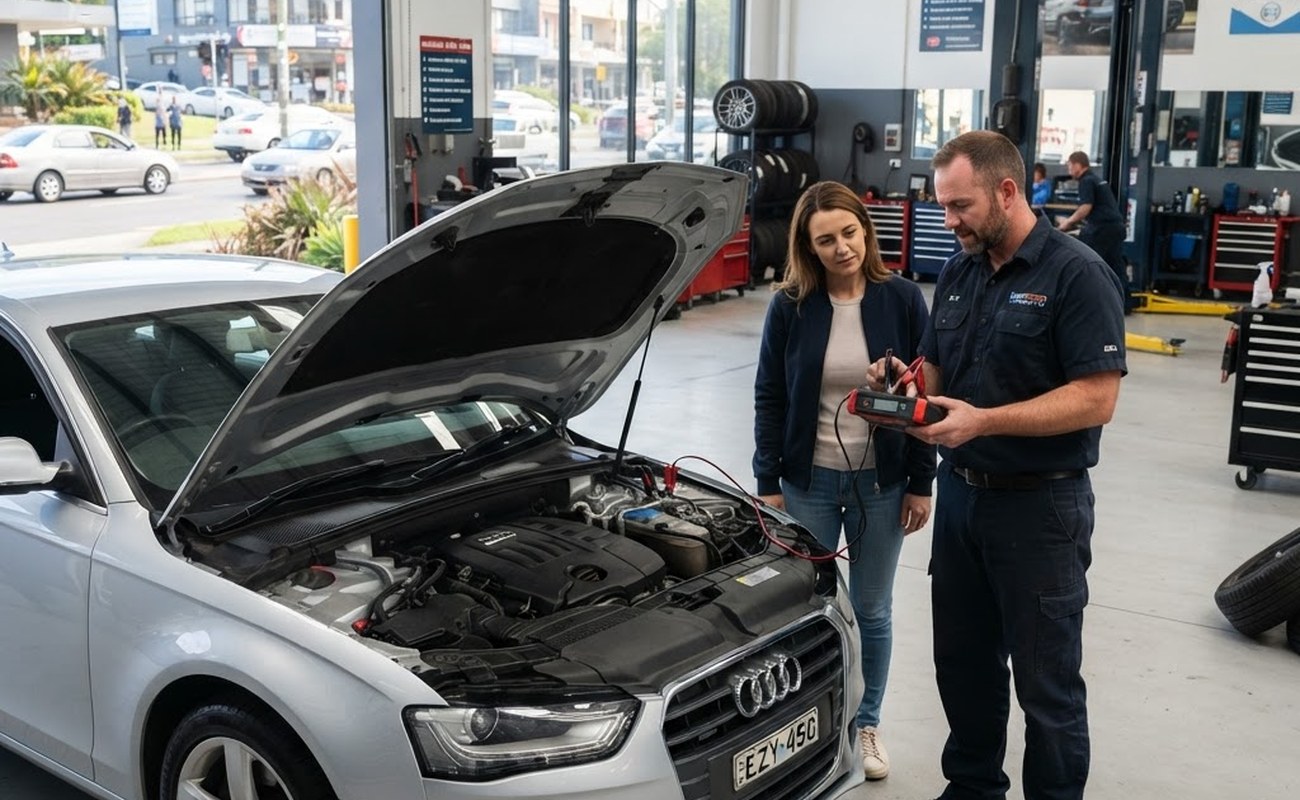
Quick Answer: Most European cars that won’t start come down to the battery, a poor connection, or the starter motor — but Euro cars add a few quirks of their own: immobiliser systems that block the crank entirely, crank sensors and fuel pump relays that fail when hot, and batteries that need coding after replacement. At West Ryde Service Centre on Victoria Road in Sydney we diagnose Audi, BMW, Mercedes-Benz and VW starting faults with factory-level scan tools, usually the same day. The sound your car makes when it won’t start — or the silence — tells us most of what we need to know before we even plug in.
There’s a particular kind of dread that comes with turning the key and getting nothing. I’ve been fixing European cars across Sydney for decades, and a no-start is almost never a mystery. It’s a chain — battery, starter, fuel, spark, and on modern European cars, electronics — and the fault is always in one link of that chain. The trick is knowing which link, and that’s where a proper diagnosis beats guessing and swapping parts.
What catches European car owners out is that their cars behave differently to the family Toyota when things go wrong. A BMW can refuse to crank because its immobiliser isn’t happy. A Golf can start perfectly every morning and then refuse to fire after a warm run to the shops. And if you replace a battery in a late-model BMW or Mercedes without coding it, you’ve created your next problem.
Common Symptoms: What the Sound Tells You
Before you call anyone, work out which of these five patterns you’ve got. Each points somewhere different, and being able to describe it accurately saves real time and money.
- Nothing at all. No dash lights, or very dim ones, and total silence when you turn the key. That’s almost always a flat battery or a major connection failure.
- Dash lights up, but no crank. The electrics work, but the engine doesn’t even try to turn. On European cars this is where the immobiliser enters the conversation, along with starter circuit faults.
- A single loud click. You turn the key, get one solid clunk, and nothing else. Classic starter motor or starter solenoid territory.
- Rapid clicking. Tick-tick-tick-tick when you turn the key. That’s a battery too flat to crank — often with enough charge to work the lights but not the starter.
- Cranks strongly but won’t fire. The starter is doing its job, the engine spins freely, but it never catches. Now you’re looking at fuel supply, spark, or a sensor like the crank position sensor lying to the engine computer.
One more pattern worth naming: the intermittent no-start. Fine yesterday, dead this morning, fine again tomorrow. These get misdiagnosed most often, because whatever’s failing often looks fine when it’s cool or when a basic scan tool is connected. More on that below.
Possible Causes of Starting Problems
Battery and Connections
The number one cause of no-starts, full stop. In Australia heat kills batteries faster than cold — expect roughly 3–5 years in Sydney conditions. Stop-start cars usually run AGM batteries, which cost significantly more than standard lead-acid. Corroded or loose terminals cause just as many no-starts as dead cells do.
Starter Motor and Solenoid
The starter takes a hammering every time you start the car. Worn brushes or a tired solenoid show up as that single loud click with no crank, or a starter that works only when cold. Supplying and fitting a replacement on a European car typically runs $400–$1,000 in Sydney.
Immobiliser and Security System
Modern BMW, Mercedes, Audi and VW cars check the key against the security system before allowing a crank. If the handshake fails — flat key-fob battery, an EWS or CAS module fault, or low system voltage confusing it — the engine won’t even try to turn over, even with a healthy battery.
Crank Position Sensor
The engine computer needs this sensor to know when to fire the injectors and coils. When it fails on a VW or Audi, the classic signature is a car that starts cold every time but won’t restart warm, then works again once it cools down.
Fuel Pump and Relay
A failed fuel pump gives you strong cranking with no firing. The cheaper and sneakier culprit is the fuel pump relay — a well-known weak point on VW group cars, widely reported by owners — which can fail hot and recover cold, mimicking a sensor fault.
Parasitic Drain
Something staying awake after you lock the car — a module, an aftermarket accessory, a boot light — quietly flattens the battery over days. The tell-tale: fine when driven daily, dead after a long weekend.
How We Diagnose a No-Start
Here’s the process we run at the workshop, in order. It’s deliberately boring — we check the likely causes first instead of jumping to expensive ones.
Listen to your description first. The single-click versus rapid-click versus no-crank distinction narrows the field before we touch the car. “One clunk and nothing” sends us straight to the starter circuit; “cranks but won’t fire” sends us down a fuel and spark path.
Test the battery and charging system. A proper load test, not just a voltage glance. We check resting voltage, cranking voltage, alternator output and the condition of the terminals and earth straps. This catches the majority of no-starts in the first fifteen minutes.
Scan the whole car with factory-level tools. ODIS for Volkswagen and Audi, ISTA for BMW, XENTRY for Mercedes. Generic scan tools miss immobiliser codes and security-event logs that these tools show plainly. If the EWS or CAS has blocked a start, it’s recorded.
Check the inputs the engine needs to fire. Live data shows the crank sensor signal, fuel pressure and injector activation while the engine cranks. This is where warm-no-start faults get pinned down — we watch the sensor signal drop out in real time.
Voltage-drop test the starter circuit. If the battery tests healthy and the car still won’t crank, we measure exactly where voltage is being lost between the battery, the starter and its earth path. This separates a starter motor fault from a wiring or connection fault.
Repair, retest, and finish the job properly. On cars that need it, we code and register the new battery to the vehicle so the charging system manages it correctly — a step plenty of workshops skip, and the reason some “new battery” no-starts come back.
What Happens If You Ignore It
A starting problem never fixes itself. Keep cranking a dying battery and you’ll cook the starter motor too — turning one repair into two. Running a European car’s electrical system on low voltage can also damage control modules and leave fault codes that take real time to untangle. And an intermittent fault that strands you once will strand you again, usually at the worst moment: a school pickup on Victoria Road, or a Friday night car park. Diagnose it once, properly, and it’s done.
How West Ryde Service Centre Can Help
Our workshop at 1135 Victoria Rd, West Ryde has been handling European cars since 1981 — 45 years of Audi, BMW, Mercedes-Benz and Volkswagen starting systems under our roof. We run factory-level diagnostic equipment, so we see what the dealer sees without dealer prices. Every diagnosis starts with the battery and charging test, because we’d rather fix the $250 cause than sell you the $900 one. Call us on (02) 9874 7684, and if you can tell us which of the five symptom patterns you’ve got, you’ve done the first diagnostic step for us.
We’re an independent European specialist — not a dealer — and our logbook servicing keeps your new car warranty intact. All our work carries a lifetime workmanship guarantee. For the full run-down of what we cover, see our mechanical repairs and car servicing page.
Brand-Specific Starting Issues We See
European cars share the same starting chain, but each brand breaks it in its own characteristic ways. These are the patterns that walk through our door regularly.
BMW: The classic BMW no-crank is security-related — the EWS or CAS immobiliser refusing the handshake, often triggered or accompanied by low battery voltage. BMWs are also unforgiving about battery quality: many run AGM batteries and require the new battery to be registered to the car, so the charging system knows what it’s managing. If your BMW is turning over but not firing, fuel pump and crank sensor faults are the usual suspects. For scheduled work on these cars, our BMW service in Sydney page covers what’s involved.
Volkswagen and Audi: The signature VW group fault is the warm no-start — starts cold every morning, refuses after a short warm drive, then starts again an hour later. The crank position sensor and the fuel pump relay are the two well-known culprits, both widely reported by owners, and both are cheap compared with the fuel pump they get blamed for. Carbon build-up on direct-injection petrol engines can add hard starting when warm as the car ages. If you drive one of these, our VW service in Sydney team sees these faults weekly.
Mercedes-Benz: Mercedes no-starts often trace back to the key rather than the car — a flat key-fob battery breaking the security handshake — or to interlocks that prevent a crank when the electronic selector doesn’t see a confirmed Park or Neutral. Late-model Mercedes also need battery coding after replacement. A related read if your Mercedes starts but then behaves oddly: our guide to limp mode in European cars.
A recent case that shows how this works: a VW Tiguan 162TSI came to us — perfect cold starts, but after a twenty-minute run it would crank strongly and not fire until it cooled. The owner had already replaced the battery elsewhere for the same symptom. Twenty minutes watching live data while the engine was still warm showed the crank sensor signal dropping clean out. Sensor replaced, coded to the car, first-time starts ever since. That’s the difference between guessing at the chain and testing it.
Sydney Context: Why Your Battery Hates Summer
Almost everything you read online about no-starts talks about cold weather. That’s Northern Hemisphere advice. In Sydney it’s heat that shortens battery life — the chemical reaction inside a battery accelerates in hot weather, and a battery that might last six years in a European winter often gives up after three to five Australian summers. Parking on hot asphalt all day, whether at Macquarie Park or a West Ryde commuter car park, accelerates it further.
We also see the station commuters: a car parked at West Ryde or Meadowbank station Monday to Friday, driven only on weekends. Low-use cars never fully recharge their battery, and any parasitic drain has all week to do its damage. Then there’s stop-start traffic on Victoria Road and the M2, where a car with start-stop cranks its engine dozens of extra times per trip — genuinely hard work for both battery and starter. Plenty of our Gladesville customers come to us for exactly this: a battery test and, if needed, a properly coded replacement before the car strands them.
If your car is running hot as well as struggling to start, that’s a different conversation — see our guide to overheating in European cars. And if what you’re hearing at startup is a rattle rather than silence, our article on timing chain rattle on startup covers that separately.
Related Services and Articles
- Car battery replacement in Sydney — testing, supply and coding of standard and AGM batteries for European cars
- Mechanical repairs and car servicing — starters, alternators and full electrical diagnostics
- BMW service in Sydney — battery registration, EWS diagnosis and scheduled servicing
- VW service in Sydney — crank sensors, fuel pump relays and warm no-start diagnosis
- European car repairs in Sydney — everything we cover across Audi, BMW, Mercedes and VW
Frequently Asked Questions
Why won’t my BMW start but the lights work?
If the lights and dash work but the engine won’t crank, the battery has enough charge for accessories but something is blocking the crank. On a BMW the most common cause is the immobiliser (EWS or CAS) refusing the key handshake, often triggered by low voltage, followed by starter circuit faults. A scan with factory-level tools shows security events that point straight at the cause.
What does a single loud click mean when I try to start my car?
One solid click and nothing else usually means the starter solenoid is engaging but the starter motor isn’t turning the engine. That’s starter motor territory — worn brushes or a tired solenoid. It’s occasionally caused by a poor connection not delivering enough current, so we always voltage-drop test the circuit before condemning the starter.
Why does my car click rapidly but not start?
Rapid clicking means the battery is too flat to crank the engine — enough charge to pull in the starter relay repeatedly, but not enough to turn the engine over. The battery either needs charging, has failed, or is being drained overnight by a parasitic draw. Get it load-tested before assuming it’s dead; sometimes an alternator fault or a drain is the real problem.
Why does my VW or Audi crank but not start?
Strong cranking with no firing points to fuel or spark, not the starter or battery. The two classic VW group culprits are the crank position sensor and the fuel pump relay — both are known to fail when hot and recover when cool, which is why the signature symptom is a car that starts cold but won’t restart after a warm drive. Carbon build-up on direct-injection engines is a third possibility on higher-kilometre cars.
Do European cars need battery coding after replacement?
Many late-model BMW and Mercedes-Benz vehicles do. The charging system is programmed to manage the specific battery fitted from the factory, including its type and age. If you fit a new battery without registering and coding it, the car can overcharge or undercharge it, shortening its life and sometimes triggering electrical faults. We code and register batteries as standard practice on cars that require it.
Is it the battery or the starter motor?
The sound gives it away. Rapid clicking or dim lights points to the battery. A single loud click with healthy dash lights points to the starter. Total silence points to the battery, a major connection, or the immobiliser. The definitive answer comes from a battery load test followed by a voltage-drop test of the starter circuit — fifteen minutes of testing at the workshop beats a guess every time.
How much does it cost to fix a car that won’t start in Sydney?
It depends on which link in the chain has failed. Battery replacement starts from around $140 for a basic lead-acid unit, with AGM batteries for stop-start cars costing significantly more; NSW installation labour typically adds $120–$280. Starter motor replacement on a European car typically runs $400–$1,000 supplied and fitted (industry cost data from AutoGuru). Diagnosis is quote-based — contact us for pricing on your car.
How long should a car battery last in Sydney?
Typically three to five years in Australian conditions. Heat is the main killer here, not cold — the battery’s internal reaction accelerates in hot weather, and cars parked outside all day in full sun age faster. If your battery is past four years and your car is cranking slower than it used to, have it tested before it fails completely.
Need Expert Car Servicing in Sydney?
West Ryde Service Centre has been Sydney's trusted European and hybrid car specialist since 1981. Book your service today.
Book a Service Call (02) 9874 7684
Related Post

Rough Idle in European Cars: Vacuum Leaks, Coils & Carbon..
Quick Answer: A rough idle means your engine is struggling to run smoothly at low..

Check Engine Light in European Cars: Common Codes & What..
Quick Answer: The check engine light means your car's computer has stored a fault code..