
Phone
9874 7684
-
 By: Tony
- Comments Off on BMW M3 Stage 1 vs Stage 2 Remapping: Power, Cost & Reliability
 By:
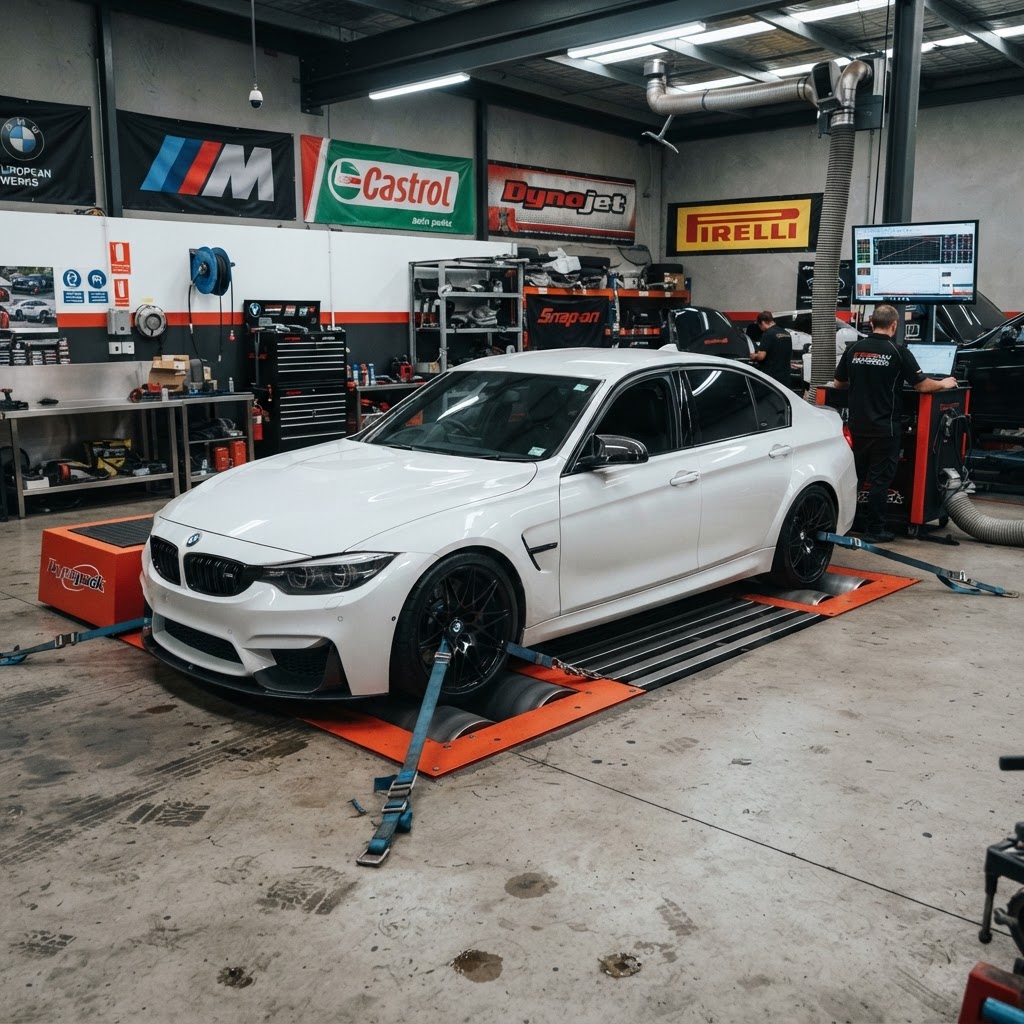
Quick Answer: A Stage 1 remap is software only and transforms a BMW M3 (F80 S55 or G80 S58) for around $500 to $900 in Sydney. Stage 2 adds downpipes to the equation, costs roughly $1,200 to $2,500 including parts and fitting, and delivers serious power but carries real reliability risks on the S55 crank hub. At West Ryde Service Centre, we use Unitronic, Revo and GT Innovation software on our in-house AWD dyno to tune both M3 generations properly.
Why M3 Owners Come to Us for Remapping
I’ve been tuning European cars on Victoria Road from our workshop in West Ryde for over four decades, and the BMW M3 is one of the most common performance cars that rolls through our doors. Whether it’s an F80 with the S55 that someone picked up secondhand, or a G80 S58 from the showroom, the question I hear most is: “Stage 1 or Stage 2, and which should I pick?”
It’s a fair question. The answer depends on which generation you’ve got, how you drive it, and how much risk you’re willing to take. Let me break it down the way I explain it to customers sitting across the counter from me.
The Two M3 Generations: S55 vs S58
Before we talk tuning stages, you need to know which engine is sitting under your bonnet, because they respond differently to modifications.
The F80 M3 (2014 to 2018) runs the S55: a 3.0-litre twin-turbo inline-six making 317 kW and 550 Nm from the factory, or 331 kW in Competition Package form. It’s a closed-deck block with a forged crankshaft, and it’s a strong platform for tuning. But it has one well-known weakness that we’ll get to shortly.
The G80 M3 (2021 onwards) runs the S58: same displacement but a redesigned engine that makes 353 kW and 550 Nm standard, or 375 kW and 650 Nm in Competition spec. BMW learned from the S55’s crank hub issues and strengthened the design from the factory, which makes the S58 a stronger base for higher-power tunes.
If you own either generation and want it serviced properly first, our BMW service page covers the logbook and maintenance work we do on the full M range.
Stage 1 vs Stage 2: What Changes?
Here’s the simplest way to think about it. Stage 1 is a software-only tune. We read your ECU, write a new calibration that increases boost pressure, optimises ignition timing, and adjusts fuel mapping for Australian 98 RON. No parts come off the car. Stage 2 is the same software work plus hardware, specifically downpipes that replace the restrictive factory catalytic converters to let the turbos breathe more freely.
Stage 1 (Software Only)
S55 (F80): Approx 520 to 540 bhp and 680 to 710 Nm at the crank. That’s around 95 to 115 hp over stock.
S58 (G80): Approx 580 to 620 HP. A meaningful jump on an already potent platform.
Cost in Sydney: $500 to $900
Hardware needed: None
Reliability risk: Low. The engine operates within limits BMW designed it to handle.
Stage 2 (Software + Downpipes)
S55 (F80): Up to 367 kW and 671 Nm measured at the wheels on 98 RON (based on published Sydney dyno data). That’s a gain of roughly 64 kW and 162 Nm at the wheels over stock.
S58 (G80): Approx 640 to 680 HP with downpipes fitted.
Cost in Sydney: $1,200 to $2,500 (software plus downpipe parts and fitting)
Hardware needed: High-flow or decatted downpipes ($800 to $2,000 for parts)
Reliability risk: Moderate on S55 (crank hub concern at over 500 whp). Low to moderate on S58.
Extras to Consider
TCU/Gearbox tune: From $400. Essential for DCT cars running Stage 2 so the transmission keeps up with the extra torque.
Crank hub upgrade (S55): $2,000 to $4,000. A preventative measure worth serious consideration before going Stage 2 on an F80.
Upgraded brakes: More power means you need more stopping power. See our brake upgrades page.
Every car is different, and actual gains vary based on fuel quality, ambient conditions, and the health of your engine. These figures represent what’s typically achievable on 98 RON pump fuel, not guarantees.
The S55 Crank Hub Problem: What Every F80 Owner Needs to Know
If you’re tuning an F80 M3, there’s one topic I raise every single time before we even hook up the dyno: the crank hub.
The S55 engine’s crank hub is a friction-based assembly that connects the crankshaft to the timing gear. At factory power levels it’s fine. But when you push past 500 wheel horsepower with a Stage 2 tune, the hub can slip. When that happens, the timing jumps and the pistons hit the valves. Engine done.
Forum and community data suggests a 10 to 20 percent chance of crank hub failure at Stage 2 power levels, with DCT cars more vulnerable than the 6-speed manual because of how hard the auto shifts load the engine. The S58 in the G80 addressed this weakness from the factory, which is one reason G80 owners can push harder with less worry.
⚠️ Tony’s take: If you own an F80 M3 and want Stage 2, budget for a crank hub upgrade at the same time. It’s not cheap (around $2,000 to $4,000), but rebuilding an S55 after a hub slip is ten times that. I’ve seen it happen. Don’t gamble with your engine to save on a preventative fix.
We don’t build crank hubs or engine internals in-house, but we diagnose, advise, and can refer you to the right specialists if you decide to go that route before a Stage 2 tune. What we do is make sure your engine is healthy enough to handle the power before we write the map.
How We Tune an M3 at West Ryde Service Centre
Here’s what happens when you bring your M3 in for a remap at our performance tuning workshop. It’s not a five-minute flash and send-you-on-your-way. I run it properly.
Pre-tune inspection
Before touching the ECU, I check the car over. Engine fault codes, oil condition, spark plugs, and any boost leaks. If your M3 needs a service first, we sort that out via our logbook servicing. Tuning a sick engine just hides problems.
Baseline dyno run
We put the car on our in-house AWD chassis dyno and run it in stock form. This gives us a real baseline number so we can measure actual gains, not just flash a file and hope.
Software calibration
We use Unitronic, Revo, or GT Innovation software platforms (we’re a dealer for all three). The map is written for your specific car, fuel quality, and hardware configuration. This isn’t a generic off-the-shelf flash. It’s calibrated on the dyno.
Post-tune dyno verification
Back on the rollers. We measure the new output, check air-fuel ratios, ignition timing, and intake temps across the rev range. If anything looks marginal, we adjust the map until it’s safe and consistent.
Road test and handover
Out on Victoria Road and up the M2 for a real-world test. We check for part-throttle smoothness, cold-start behaviour, and that the car drives as well as it dynos. Then I sit down with you and go through the before and after numbers.
What Happens If You Get a Bad Remap
I see the aftermath of cheap tunes more often than I’d like. A bloke brought an F80 M3 in a few months back that had been “Stage 2 tuned” by someone who’d flashed a generic file downloaded from a forum. The car was making decent peak numbers on paper, but it was knocking at full throttle and the intake temps were through the roof.
By the time he got to us, the spark plugs were fouled and there were traces of detonation on the pistons visible through the borescope. We pulled the tune back, did a proper mechanical inspection, and started fresh with a calibrated map. The peak numbers were slightly lower than the bad tune, but the car actually ran right and didn’t eat itself.
A bad remap can put your M3 into limp mode, trigger persistent fault codes, or worse, cause engine damage that costs five figures to fix. Generic flash tunes you download and apply at home can work, but they don’t account for your car’s health or Sydney fuel quality. A proper dyno tune means someone watched your air-fuel ratios in real time. We’ve covered the broader landscape in our general European tuning guide, and for how stages work on a different platform, the VW Golf R tuning guide walks through the same process.
Service Considerations for a Tuned M3
Tuning changes your maintenance needs. BMW calls for oil every 10,000 km and spark plugs every 36,000 km on the M-car schedule. For a tuned M3, I halve the oil interval to 7,500 km. More boost means more heat and more contaminants in the oil.
Spark plugs need closer attention too. A Stage 2 tune runs more ignition advance, which is harder on plugs. Check them at every service, not just on schedule. If you want the full picture on keeping a tuned European car healthy, our European car repairs page covers the common issues we see across all the German brands.
Is Tuning Legal in NSW?
ECU tuning is legal in NSW provided the vehicle stays emissions-compliant and roadworthy. A calibrated Stage 1 tune on a healthy engine stays within those bounds. Stage 2 with decatted downpipes gets grey from an emissions standpoint, so high-flow catted downpipes are the safer choice for a road car.
If you’re running serious power, make sure your suspension and brakes are up to the task. Acai 400 kW M3 on stock stoppers isn’t a performance upgrade, it’s a liability.
Frequently Asked Questions
How much power does a Stage 2 remap add to a BMW M3?
On the S55 (F80 M3), a Stage 2 tune with downpipes typically delivers an extra 64 kW and 162 Nm at the wheels based on published Sydney dyno data, putting it around 367 kW and 671 Nm at the wheels on 98 RON. On the S58 (G80 M3), Stage 2 can reach approximately 640 to 680 HP. Actual results vary by vehicle condition, fuel quality, and dyno type.
What is the difference between Stage 1 and Stage 2 BMW tuning?
Stage 1 is software only. We read your ECU and write a new calibration for boost, timing, and fuel mapping. No parts are removed. Stage 2 adds hardware, specifically high-flow downpipes, to let the turbos breathe more freely, combined with a revised software map to take advantage of the improved airflow.
Is Stage 2 tuning safe for a BMW M3 engine?
On the S58 (G80), Stage 2 is relatively safe since BMW addressed the crank hub weakness from the factory. On the S55 (F80), there’s a 10 to 20 percent chance of crank hub failure above 500 wheel horsepower, more so on DCT cars. We recommend a crank hub upgrade before going Stage 2 on an F80.
How much does BMW M3 remapping cost in Sydney?
Stage 1 (software only) typically costs $500 to $900 in Sydney. Stage 2 (software plus downpipe parts and fitting) runs approximately $1,200 to $2,500. Downpipe parts alone add $800 to $2,000. A TCU or gearbox tune for DCT cars starts at around $400.
Do I need downpipes for Stage 2 tuning?
Yes, downpipes are the defining hardware difference between Stage 1 and Stage 2. They replace the restrictive factory catalytic converters, allowing the turbos to spool faster and flow more exhaust gas. Without downpipes, you’re running Stage 1 regardless of what the software map says.
What is S55 crank hub failure and should I worry about it?
The S55 crank hub uses a friction coupling to drive the timing gear. Above 500 wheel horsepower, it can slip and throw the timing off, causing catastrophic valve-to-piston contact. It affects roughly 10 to 20 percent of tuned F80 M3s at Stage 2 power, with DCT cars more vulnerable. A preventative crank hub upgrade ($2,000 to $4,000) is worth considering before going Stage 2.
Can I revert my BMW M3 remap to stock?
Yes. We keep a copy of your original ECU file before writing the tune, so the car can be returned to factory specification at any time. This is useful if you sell the car or need to pass an inspection.
Will remapping void my BMW warranty?
Any ECU modification can give a dealer grounds to refuse warranty coverage on engine and drivetrain components. However, a properly calibrated tune that doesn’t push the engine beyond its mechanical limits minimises the risk. If warranty coverage is a concern, Stage 1 on a stock car is the more conservative option. Always check your warranty terms before tuning.
How often should I service a tuned BMW M3?
Reduce oil change intervals to 7,500 km instead of the factory 10,000 km. Check spark plugs at every service rather than waiting for the 36,000 km schedule. More power means more heat and stress on consumables. Regular inspections of the cooling system and charge pipes are also wise on a tuned M3.
Need Expert Car Servicing in Sydney?
West Ryde Service Centre has been Sydney's trusted European and hybrid car specialist since 1981. Book your service today.
Book a Service Call (02) 9874 7684
Related Post

Porsche Cayman Track Preparation: Brakes, Suspension & Cooling
Quick Answer: Before your Porsche Cayman goes anywhere near a track, three things decide whether..

Audi RS3 Tuning Guide: What Stage 2 Does and What..
Quick Answer: West Ryde Service Centre offers Audi RS3 tuning in Sydney using our in-house..