
Phone
9874 7684
-
 By: Tony
- Comments Off on Audi RS3 Tuning Guide: What Stage 2 Does and What It Costs
 By:

Quick Answer: West Ryde Service Centre offers Audi RS3 tuning in Sydney using our in-house AWD chassis dyno and Unitronic, Revo, and GT Innovation software. Whether you drive an 8V (DAZA engine, 2017-2020) or an 8Y (DNWC engine, 2021+), we can take your 2.5 TFSI five-cylinder from 294 kW stock to 360+ kW with a Stage 2 package. Stage 1 is software-only and costs $800-$1,500 in Sydney. Stage 2 adds hardware and runs $1,500-$3,000. We have been tuning European cars from our Victoria Road workshop since 1981.
The Audi RS3 is one of the most rewarding cars I get to work on. That 2.5-litre five-cylinder engine has a character you don’t find anywhere else in this price bracket. The sound alone is worth the entry fee. But what makes the RS3 special from a tuning perspective is how much is left on the table from the factory. Audi built this engine to handle significantly more power than they give you, and with the right software and hardware, the gains are serious.
I’ve been tuning RS3s on our dyno for a while now, and I want to walk you through what Stage 1 and Stage 2 actually do, what they cost in Sydney, and what you need to know about reliability before you go chasing bigger numbers.
The Two RS3 Generations: 8V (DAZA) vs 8Y (DNWC)
Before we talk tuning, you need to know which RS3 you have, because the two generations respond differently.
The 8V RS3 (2017-2020) runs the DAZA engine code. It’s a 2.5 TFSI inline-five making 294 kW and 480 Nm from the factory. The DAZA uses an aluminium block, which replaced the older iron-block CZGB. This is the engine most tuners love because it’s relatively unrestricted and responds well to software changes.
The 8Y RS3 (2021 onwards) runs the DNWC engine, part of the EA855 evo family. Same 294 kW and 500 Nm from the factory, but it comes with a petrol particulate filter (GPF) that restricts exhaust flow and limits tuning gains compared to the 8V. The GPF is the main reason you won’t see the same percentage gains on the 8Y as you do on the 8V.
Both generations use the 7-speed DQ500 DSG (Audi calls it S-Tronic) and Quattro all-wheel drive with a Haldex coupling. That transmission is important for tuning, and I’ll come back to it.
Stage 1 vs Stage 2: What You Actually Get
Stage 1 — Software Only
No hardware changes. Just a recalibrated ECU map. On the 8V DAZA, expect around 330-360 kW and 640 Nm at the crank. On the 8Y DNWC, typically 324-338 kW and 580-620 Nm. The GPF holds the 8Y back a bit. At the wheels, you’re looking at roughly 400+ whp from a stock 330-350 whp baseline. Sydney pricing: $800-$1,500.
Stage 2 — Hardware + Software
Requires an upgraded downpipe (decat or high-flow sport cat), upgraded intercooler, and an upgraded intake, plus ECU and TCU software. On the 8Y, Stage 2 typically delivers 360-382 kW and 650+ Nm at the crank. At the wheels, you’re pushing 450+ whp. Sydney pricing: $1,500-$3,000 for the tuning and install, plus hardware.
TCU / DSG Tune
The DQ500 DSG tune is essential at Stage 2. It increases shift speed, raises clutch clamping pressure to handle the extra torque, and sharpens launch control. Without it, the gearbox can’t manage the additional load. Sydney pricing: $650-$900. Note: the 8Y TCU is currently locked, requiring a patch via the ECU or an upgraded mechatronic unit.
I should be clear about power figures. These are typical gains based on data from tuners like MRC Tuning and what I’ve seen on our own dyno. Every car is different. Fuel quality, ambient temperature, dyno type, and individual engine health all affect the numbers. I always verify on our AWD chassis dyno rather than quoting a single figure.
How We Tune an RS3 at West Ryde Service Centre
Baseline Dyno Run
Before we touch anything, we put the car on our AWD chassis dyno and run it stock. This gives us a baseline power and torque figure to measure against. If the car isn’t making factory power, we investigate why before tuning. A boost leak or faulty sensor will eat your gains.
Diagnostic Scan
We run a full ODIS diagnostic scan to check for any stored fault codes. If there are underlying issues, they need to be resolved first. Tuning on top of a fault is a waste of your money.
Software Installation
We flash the ECU with the appropriate Stage 1 or Stage 2 map using Unitronic, Revo, or GT Innovation software. For Stage 2, we also flash the TCU to handle the extra torque.
Post-Tune Dyno Verification
Back on the dyno to confirm the gains. We check air-fuel ratios, boost pressure, and timing to make sure everything is running safely. If the map needs adjusting, we do it there and then.
Road Test and Handover
Final road test to verify drivability in real conditions, then we hand the car back with before-and-after dyno graphs.
DAZA and DNWC Reliability: What to Watch
The 2.5 TFSI is a strong engine, but it’s not bulletproof, especially once you start turning up the wick. Here are the issues I see regularly in the workshop.
Carbon build-up on intake valves. This is the big one for direct injection engines. Carbon accumulates on the back of the intake valves over time, and you’ll notice it as reduced throttle response, rough idle, and a general feeling that the car isn’t as sharp as it used to be. We walnut-blast the intake valves at around 50,000-65,000 km. If your RS3 is tuned, the extra combustion heat can accelerate carbon formation, so keep an eye on it.
Turbo and boost issues. The factory diverter valve is a known weak point. Under increased boost from a tune, it can fail and cause boost leaks. You’ll hear it as a whooshing sound under load or notice inconsistent power. We had an 8V DAZA in last month that had been tuned elsewhere with a generic map. The owner complained about erratic power delivery and a surging feeling under hard acceleration. We put it on the dyno and could see boost spikes of 2.6 bar before the ECU cut fuel to protect the engine. The previous tune was dangerous. We reflashed it with proper Unitronic software, replaced the diverter valve, and the car made smooth, consistent power across the rev range.
Oil consumption and PCV faults. The PCV system on the 2.5 TFSI can cause excessive crankcase pressure, leading to oil blow-by and accelerated piston ring wear. Audi considers oil consumption up to 0.5L per 1,000 km to be within specification, which sounds high to me. If you’re topping up oil regularly, get the PCV system checked.
Water pump and thermostat housing. These can leak or fail outright. If you see coolant temperature creeping above normal, stop driving and get it looked at. An overheated five-cylinder is an expensive mistake.
DQ500 DSG whine. A high-pitched whining noise on cold starts can indicate a DSG pump issue or a problem with the transmission cooling system. Caught early, it’s manageable. Ignore it and you could be looking at a mechatronic unit failure. We diagnosed this on an 8Y RS3 recently, caught it before it became a full transmission replacement, and saved the customer thousands.
Important: If you’re running a Stage 2 tune, shorten your oil change interval to 10,000 km instead of the factory 15,000 km. The extra heat and stress from increased power break down oil faster. DQ500 DSG fluid should be changed every 60,000 km, and Haldex fluid every three years. Audi does not clean the Haldex pump strainer during standard service, so have it inspected independently. A clogged strainer means your Quattro system is not functioning properly, and on a tuned RS3 that’s a serious safety concern.
NSW Legality: Is Tuning Legal?
ECU tuning is legal in NSW as long as the vehicle remains emissions-compliant and roadworthy. A software-only Stage 1 tune generally doesn’t cause issues. Where you need to be careful is with Stage 2 hardware, particularly decat downpipes. Removing the catalytic converter or GPF can affect emissions compliance, and if your car fails an emissions test or is deemed unroadworthy, it’s defectable. I always discuss this with customers before installing hardware. A high-flow sport cat is a safer option than a full decat if you want to stay on the right side of the law.
How West Ryde Service Centre Can Help
We’ve been working on European cars from our workshop at 1135 Victoria Road, West Ryde since 1981. We have an in-house AWD chassis dyno, which means every tune we do is verified with real data, not just a file someone emailed you. We’re a dealer for Unitronic, Revo, and GT Innovation tuning software, and we handle everything from the ECU and TCU flash to downpipe installation and intercooler upgrades.
Our approach is simple: baseline the car on the dyno, fix any underlying issues, flash the right software, verify the results, and hand it back with graphs. No generic maps, no guesswork. If you’re in Sydney and thinking about tuning your RS3, give us a call on (02) 9874 7684 or visit us in West Ryde.
Audi Expertise at WRSC
We service and tune the full Audi range, from the A1 through to the R8. That includes the RS3, RS4, RS6, S3, S4, and everything in between. Our Audi-specific expertise covers the 2.0 TFSI, 2.5 TFSI, 3.0 TFSI, and 4.0 TFSI engines, along with DSG and S-Tronic transmission work. If you want a broader look at what’s possible, check our Audi performance upgrades guide. For DSG-specific concerns, our Audi transmission problems guide covers S-Tronic issues in detail.
Related Articles
- BMW M3 Stage 1 vs Stage 2 Remapping — our guide to M3 tuning, covering the S55 and S58 engines
- VW Golf R EA888 Tuning Guide — Stage 1 and Stage 2 for the 2.0 TSI platform
- Limp Mode in European Cars — what to do when your tuned car goes into limp mode
- Performance Brake Upgrades — because more power means you need more stopping force
- Suspension Upgrades for Performance — getting the power to the ground
- European Car Repairs Sydney — our full European vehicle service coverage
- Mechanical Repairs & Car Servicing — general mechanical services
- Logbook Servicing — keep your warranty intact with manufacturer-specified servicing
For more car advice and guides, visit our car advice page.
Frequently Asked Questions
How much power does an Audi RS3 Stage 2 tune make?
A Stage 2 tune on an 8Y RS3 (DNWC engine) typically produces 360-382 kW and 650+ Nm at the crank, or around 450+ wheel horsepower. On the 8V DAZA, gains can be slightly higher due to the absence of a GPF. These are typical figures that vary by vehicle condition, fuel quality, and dyno type. We verify all gains on our in-house AWD chassis dyno.
How much does Audi RS3 tuning cost in Sydney?
Stage 1 (software only) typically costs $800-$1,500 in Sydney. Stage 2 (hardware plus software) runs $1,500-$3,000 for the tuning and installation, plus the cost of hardware like a downpipe ($800-$2,000) and intercooler ($800-$1,500). A DQ500 DSG/TCU tune adds $650-$900. These are market ranges, not specific quotes.
Is the Audi RS3 2.5 TFSI reliable after tuning?
The 2.5 TFSI is a robust engine, but tuning increases stress on components. The main reliability concerns are carbon build-up on intake valves, diverter valve failure, PCV system faults, and water pump issues. With proper maintenance (shorter oil intervals at 10,000 km, DSG fluid every 60,000 km, Haldex service every three years, and carbon cleaning at 50,000-65,000 km), a tuned RS3 can remain reliable.
What is the difference between RS3 Stage 1 and Stage 2?
Stage 1 is a software-only ECU remap with no hardware changes. Stage 2 requires hardware upgrades (downpipe, intercooler, intake) alongside the ECU and TCU software. Stage 1 gives you a solid bump in power for minimal cost. Stage 2 delivers significantly more power and torque but requires more investment and hardware installation.
Does tuning void the Audi warranty?
Generally, ECU tuning will void the powertrain portion of your factory warranty, as the manufacturer can point to the modified software as the cause of any engine or transmission failure. If your RS3 is still under warranty, consider this carefully. Some tuning software offers warranty-style guarantees, but these are from the tuning company, not Audi. We always discuss warranty implications with customers before proceeding.
Do I need to tune the DSG transmission on a tuned RS3?
At Stage 1, a TCU tune is optional but recommended for improved shift quality. At Stage 2, a DQ500 DSG/TCU tune is essential because the extra torque requires increased clutch clamping pressure to prevent slippage. On the 8Y RS3, the TCU is currently locked, requiring a patch via the ECU or an upgraded mechatronic unit.
What is the Haldex strainer issue on the RS3?
The Haldex coupling that powers the Quattro all-wheel drive system has a pump strainer that clogs with clutch dust over time. Audi does not clean this strainer during standard servicing. A clogged strainer means the all-wheel drive system may not function properly, which is especially dangerous on a tuned RS3 with significantly more power. We recommend having the strainer inspected during Haldex fluid changes every three years.
Is ECU tuning legal in NSW?
ECU tuning is legal in NSW if the vehicle remains emissions-compliant and roadworthy. Software-only Stage 1 tunes generally don’t cause issues. Stage 2 hardware, particularly decat downpipes, can affect emissions compliance and may be defectable if the vehicle fails an emissions test. A high-flow sport cat is a safer legal option than a full decat.
Can I tune my RS3 myself with a DIY kit?
DIY tuning kits are available, but I don’t recommend them for the RS3. The 2.5 TFSI is a high-performance engine that requires careful calibration. A generic or poorly matched map can cause boost spikes, lean conditions, and engine damage. Professional tuning with dyno verification ensures the map is safe and optimised for your specific vehicle. The cost difference is minimal compared to the risk.
Need Expert Car Servicing in Sydney?
West Ryde Service Centre has been Sydney's trusted European and hybrid car specialist since 1981. Book your service today.
Book a Service Call (02) 9874 7684
Related Post

Porsche Cayman Track Preparation: Brakes, Suspension & Cooling
Quick Answer: Before your Porsche Cayman goes anywhere near a track, three things decide whether..
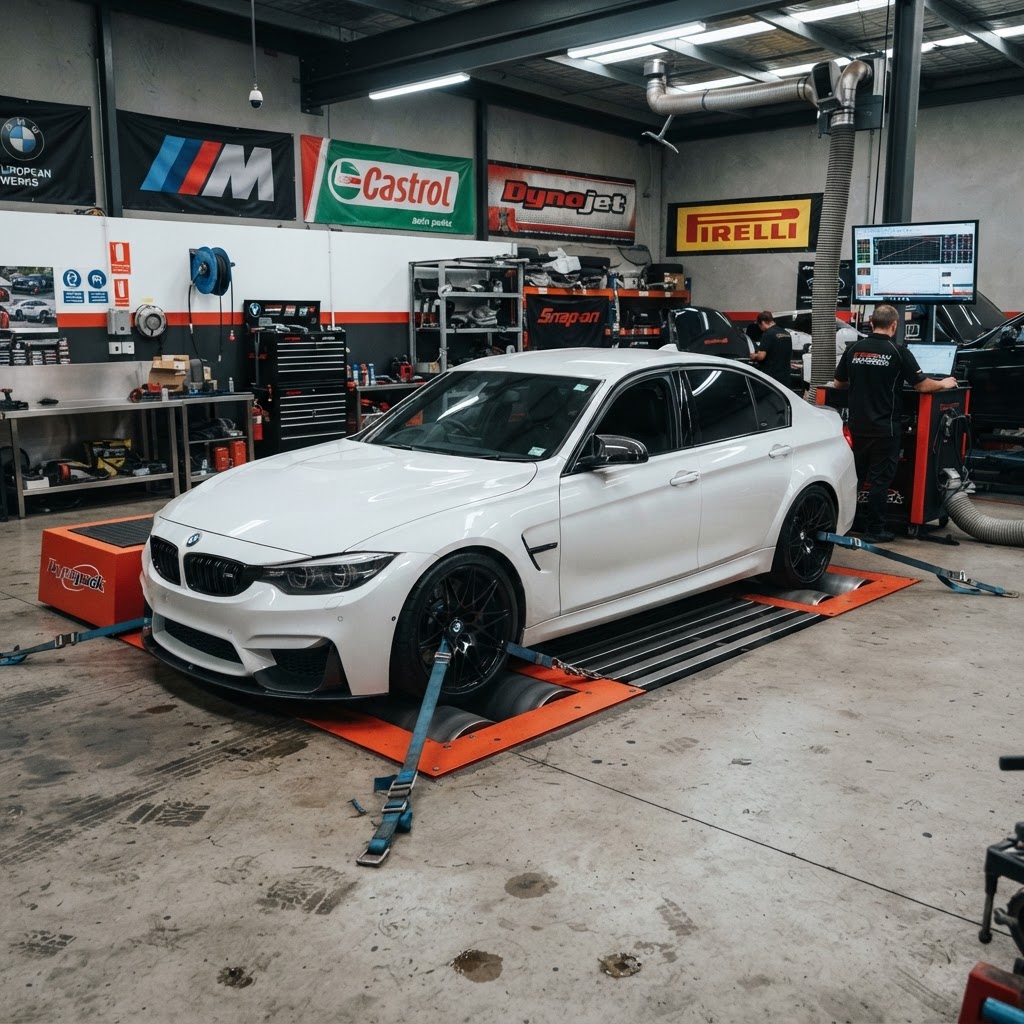
BMW M3 Stage 1 vs Stage 2 Remapping: Power, Cost..
Quick Answer: A Stage 1 remap is software only and transforms a BMW M3 (F80..