
Phone
9874 7684
-
 By: Tony
- Comments Off on VW Golf Common Problems: A Mechanic’s Guide
 By:
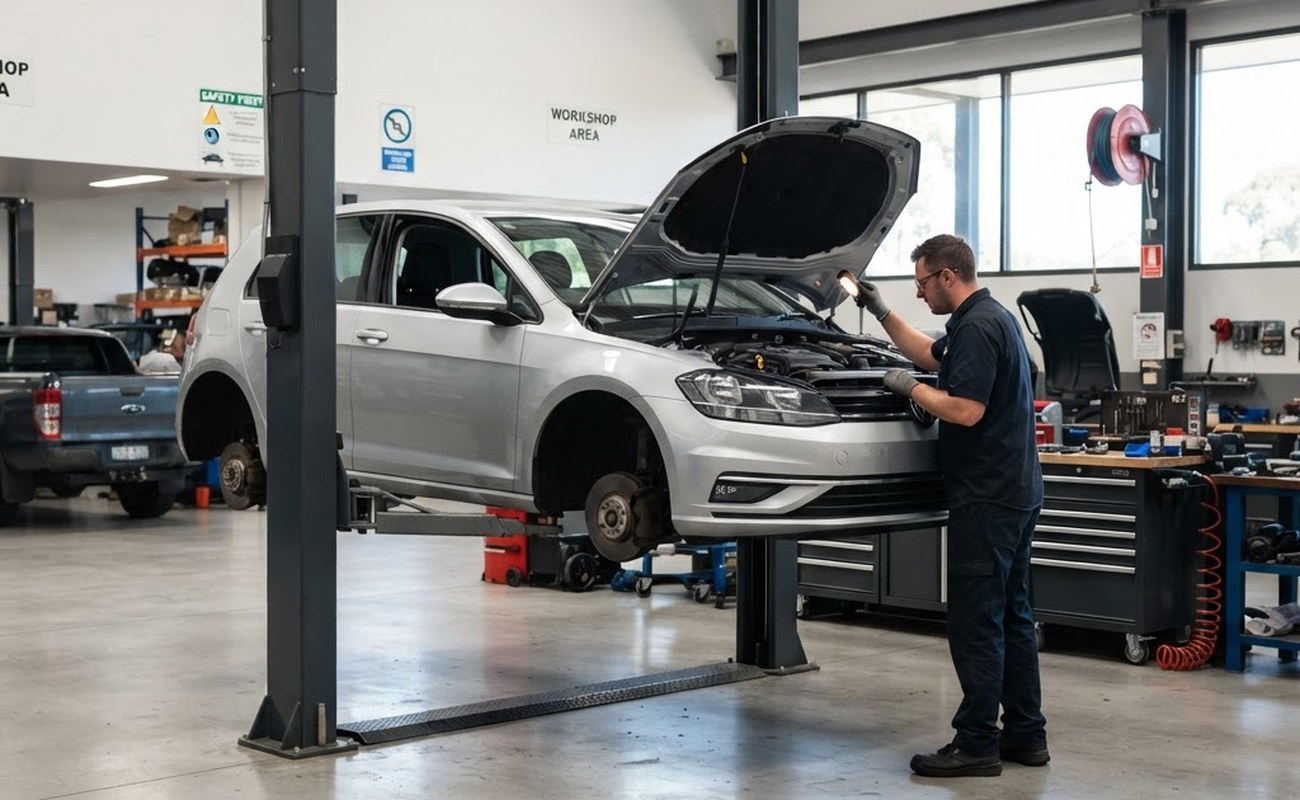
Quick Answer: The most common VW Golf problems we see at West Ryde Service Centre are timing chain tensioner failure on MK6-era TSI engines, coolant leaks from plastic water pump housings on MK7 models, carbon build-up on direct-injection engines, DSG shudder on dry-clutch gearboxes, and worn front suspension bushes. We’re an independent VW specialist workshop in West Ryde, Sydney, and we’ve been fixing every generation of Golf since 1981, with 240+ Google reviews behind us.
Last month a 2012 MK6 118TSI came in from Meadowbank with a cold-start rattle the owner had been noticing since June. He thought it was a sticky valve lifter. The timing deviation readings said stretched chain and a tired tensioner: a $1,600 job caught in time, on the M2 every morning, instead of the replacement engine it very nearly became.
Common Symptoms
The good news about the Golf is that it almost never fails without warning. The bad news is that owners often drive past the warnings for months. Here’s what we see in the workshop, week after week:
- A metallic rattle for one to three seconds on cold start-up. That’s the classic timing chain tensioner complaint on MK5 and MK6-era TSI engines. It lengthens as the chain stretches.
- Coolant dropping, with pink or green crust around the water pump area. The plastic water pump and thermostat housings on MK7-era engines weep slowly long before they let go properly.
- Rough idle, an occasional misfire, or the EPC light coming on. Sometimes alongside limp mode, which usually points to ignition coils, carbon build-up, or a PCV fault.
- Shudder or judder when taking off from rest, especially creeping in traffic. That’s the dry-clutch DSG asking for attention.
- Clunks and knocks over speed bumps and potholes. Worn front control arm bushes and sway bar links, mostly.
- A battery that struggles after a few days of short trips. Golfs doing stop-start commutes chew through batteries if the charging system isn’t checked.
If your Golf is showing any of these, don’t wait for the symptom to mature. The difference between catching these faults early and ignoring them is regularly the difference between hundreds and thousands of dollars. Our battery replacement service covers the electrical side, and we’ll tell you honestly when a battery isn’t the real problem.
Possible Causes: Generation by Generation
Golf problems are generation-specific, so it helps to know which engine is in yours before panicking about internet horror stories. Here’s how the faults break down:
MK5/MK6 TSI Timing Chain Tensioner (2005-2013)
The big one. The 118TSI’s twincharged 1.4 (engine codes CAXA, CAVD) and the MK6 GTI’s EA888 (CCZB) both used a chain tensioner that struggles to hold oil pressure on start-up. The chain stretches, the rattle grows, and the engine eventually skips a tooth. We cover the warning signs in our timing chain rattle guide.
MK7/MK7.5 Water Pump & Thermostat Housing (2013-2020)
The 1.8 and 2.0 EA888 Gen 3 engines in the 132TSI, GTI and R use a plastic water pump and thermostat housing assembly that weeps coolant, typically from around 60,000 to 100,000km. Left alone, the weep becomes a pour. Our guide to coolant leaks in European cars explains how to track it down.
Carbon Build-Up on Intake Valves (all TSI engines)
Every direct-injection Golf, from the MK5 GTI through the MK8, lets carbon accumulate on the intake valves because fuel never washes them clean. The result is a lumpy cold idle, hesitation off the line, and a check engine light for lean running or misfires. Walnut shell blasting is the proper fix, and it restores the engine to how it left the factory.
DSG Clutch Packs & Mechatronics
The 7-speed dry-clutch DQ200 in the 118TSI and 110TSI is the one to watch: shudder at take-off, juddering in second gear and harsh low-speed shifts are the early signs; a worn clutch pack or mechatronic unit is the late sign. The wet-clutch 6-speed in the GTI and R is tougher but still wants its fluid on schedule. We break the whole system down in our DSG mechatronic problems guide.
Suspension Bushes & Links
Golfs are light cars, but Sydney roads sort out the front control arm bushes and sway bar links by 100,000km. Clunks over bumps, vague steering, and uneven tyre wear on the inside edge are the usual giveaways.
The 1.4 TSI Twincharger Caveat (MK6 118TSI, CAVD)
Widely reported by owners and specialists alike: the twincharged CAVD can suffer piston and valve damage, usually with the timing chain as the trigger. If you’re buying a used MK6 118TSI, service history and a cold-start listen are non-negotiable.
How the Problem is Diagnosed
Every Golf fault we chase goes through the same process, and it’s the reason we don’t sell parts based on guesses:
What Happens If You Ignore It
This is where Golf ownership gets expensive. A stretched timing chain that’s rattling on start-up can skip at any time, and when it does, the valves meet the pistons. That turns a chain and tensioner job, typically $1,200 to $2,000 in Sydney, into a replacement engine or a written-off car. Ignored coolant loss ends in overheating, a warped head or a head gasket at several thousand dollars. DSG shudder left alone escalates from a fluid and adaptation service, typically $600 to $950, to clutch pack and mechatronic repairs, which one owner we spoke to recently reported at around $5,000. Every one of these faults gives you a window. Use it.
We’d rather see a tensioner-rattle owner a month early than a week late. It’s the difference between a car that drives home and one that comes in on a tilt tray.
How West Ryde Service Centre Can Help
We’re an independent European specialist workshop in West Ryde, and Golfs have been on our hoists since we opened in 1981. Everything on this page we see regularly: TSI chains, water pump housings, DSG clutch packs, carbon build-up on direct-injection engines. We run VCDS and ODIS factory-level diagnostics, we service all Golf variants from the 110TSI through to the GTI and R plus the diesels, and every job keeps your logbook servicing record compliant with the manufacturer’s schedule.
If you’re looking for VW service in Sydney, bring the car to us with the rego and any warning you’ve noticed, and we’ll tell you exactly what it needs before you spend a dollar. We also do pre-purchase inspections on used Golfs, which for a MK6 118TSI or a high-kilometre MK7 is some of the best money you can spend.
Quotes depend on your generation, engine code and kilometres. Call us on (02) 9874 7684 or book online, and we’ll always quote before we start work.
Relevant European & Brand Expertise
The Golf shares most of its engines and gearboxes with its platform cousins, which is why our depth carries across the range. The EA888 engine in the GTI and R is the same family we cover in our Golf R EA888 tuning and reliability guide, and the DSG box in the 118TSI is the one we dissect in the mechatronic write-up linked above. If your Golf has thrown the EPC light, our VW EPC warning light guide covers what that lamp actually means and when it’s safe to drive.
We’ve been looking after VWs, Audis, BMWs, Mercedes-Benz and Porsches for Sydney owners for more than four decades, with 240+ Google reviews from customers who keep coming back. For servicing intervals and costs rather than faults, our VW Golf service guide has the full schedule, and our mechanical repairs and car servicing page covers the workshop side.
Local Context: Sydney’s West
Our workshop sits on Victoria Road in West Ryde, and a big share of the Golfs we see come from the surrounding suburbs: Meadowbank, Epping, Ryde, and plenty of our Gladesville customers doing the daily run down Victoria Road or across the Gladesville Bridge.
That commute pattern matters for Golfs. Short trips and a car that never really gets hot is the exact recipe for carbon build-up on direct-injection engines and for batteries that never fully charge. If your Golf lives on a 15-minute commute, expect the intake valves and charging system to need attention earlier than the schedule suggests.
Related Services & Articles
- VW Golf Service Guide: Intervals, Costs & Common Issues
- Limp Mode in European Cars: What It Means & What To Do
- Mechanical Repairs & Car Servicing
Frequently Asked Questions
What are the most common problems with a VW Golf?
The most common faults depend on generation: MK5/MK6-era TSI engines suffer timing chain tensioner failure and chain stretch, MK7 models weep coolant from plastic water pump and thermostat housings, direct-injection engines build carbon on the intake valves, dry-clutch DSG gearboxes shudder at take-off, and front suspension bushes wear out around 100,000km. All are well documented by owners and specialists and all are repairable at sensible cost when caught early.
Is the VW Golf reliable in Australia?
Generally yes, with generation-specific caveats. The MK7 is one of the stronger used buys; the MK6 118TSI is the one to check carefully for chain and piston history. Any Golf is reliable if it’s serviced on schedule and the known weak points are monitored. That’s a big part of what a specialist workshop does differently: we know which engine is in front of us and what to check first.
What year VW Golf has timing chain problems?
The problem is concentrated in 2008 to 2013 cars: the MK6 118TSI with the twincharged 1.4 (CAXA/CAVD) and the MK6 GTI with the early EA888. The updated tensioner design and the third-generation EA888 from the MK7 onwards largely resolved it. If a car in that range rattles for a second or two on cold start, have the chain checked before anything else.
How much does it cost to fix a VW Golf timing chain in Australia?
Timing chain replacement on a Golf typically runs $1,200 to $2,000 in Sydney, depending on engine and whether the tensioner, guides and sprockets are all replaced, which we recommend. Caught early it’s a straightforward job. Skipped, it becomes a bent-valve engine rebuild or a replacement engine.
Are DSG Golfs reliable?
The wet-clutch 6-speed DSG in the GTI and R is a tough unit. The 7-speed dry-clutch unit in the 118TSI and 110TSI is the one that needs respect: fluid and adaptation services on schedule, and early attention to any take-off shudder. Driven and serviced properly, DSG Golfs give good service; neglected, they get very expensive.
Is a used VW Golf a good buy in Australia?
A well-serviced MK7 is one of the best used small cars in the country. For a MK6, insist on service history and get a pre-purchase inspection that includes a cold start and a scan. We do these inspections regularly at West Ryde, and a $150 check occasionally saves someone a $5,000 engine or gearbox.
Why is my VW Golf losing coolant?
The most likely culprit on a MK7 is the plastic water pump or thermostat housing, which weeps slowly before failing. On older cars, check hoses and the expansion tank. Any unexplained coolant loss deserves a pressure test before it becomes an overheating event, which on these aluminium engines can escalate quickly.
Does independent servicing affect my Golf’s warranty?
No. Under Australian Consumer Law, having your Golf serviced by an independent workshop doesn’t void your warranty, as long as the work is done correctly with appropriate parts and recorded in your logbook. We keep every Golf’s logbook record complete and compliant.
Can you service my Golf GTI or Golf R, or only the base models?
All of them. We service every Golf variant sold in Australia, from the 110TSI through the GTI, R and the diesels, plus the platform cousins like the Audi A3. High-performance versions get the same specialist diagnostics with an eye on the known EA888 and DSG watch points.
Need Expert Car Servicing in Sydney?
West Ryde Service Centre has been Sydney's trusted European and hybrid car specialist since 1981. Book your service today.
Book a Service Call (02) 9874 7684
Related Post

DSG Service Intervals: How Often Should You Change the Oil?
If you own a Volkswagen Group car with a DSG gearbox, the service schedule is..

VW Golf R EA888 Engine: Tuning Stages and Reliability Guide
Quick Answer: The EA888 Gen 3 in the VW Golf R is one of the..