
Phone
9874 7684
-
 By: Tony
- Comments Off on Mercedes Transmission Problems: 9G-Tronic Warning Signs
 By:
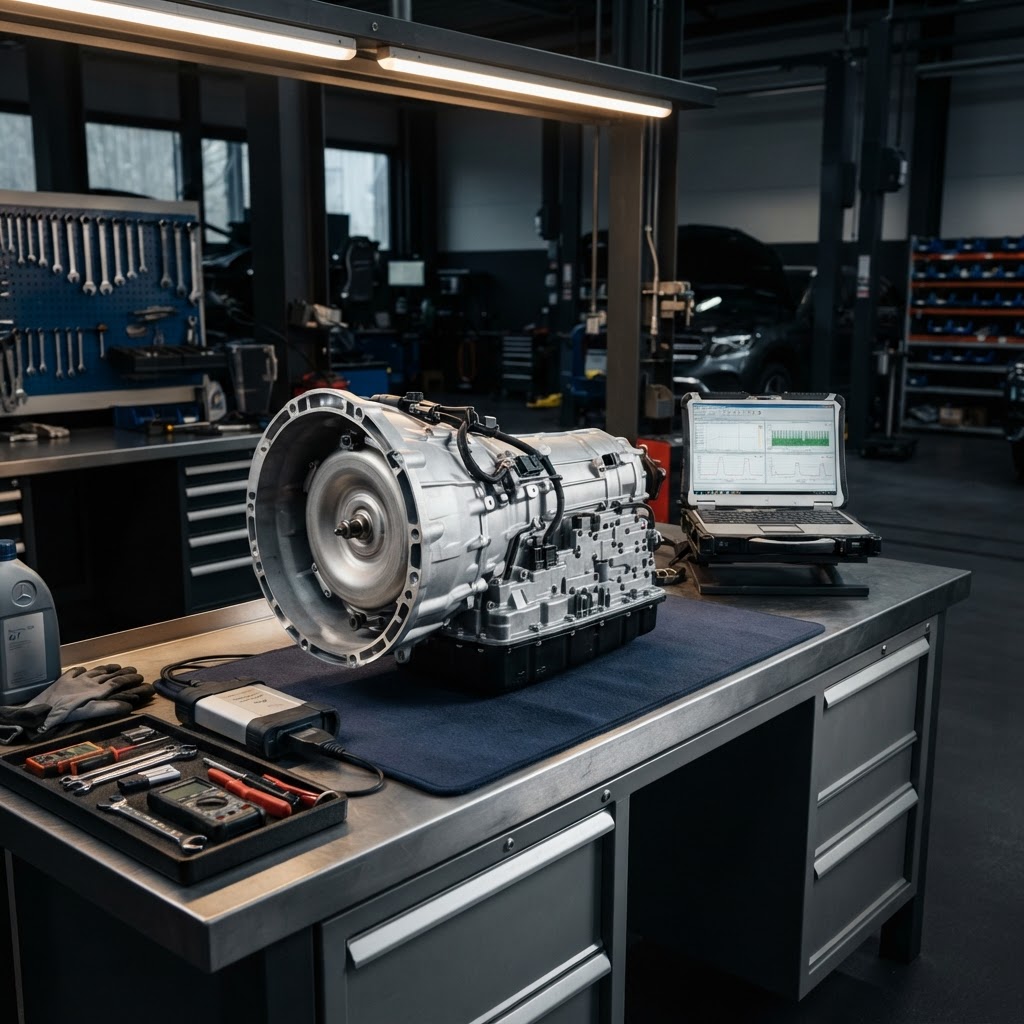
Quick Answer: Mercedes transmission problems most commonly affect the 7G-Tronic (722.9) and 9G-Tronic (725.0) gearboxes. Symptoms include harsh shifts between certain gears, low-speed shudder on deceleration, delayed engagement when selecting Drive, and limp mode with warning messages. At West Ryde Service Centre in West Ryde, Sydney, we use Mercedes XENTRY diagnostics to pinpoint whether the issue is a conductor plate, valve body, torque converter, or fluid problem across the C-Class, E-Class, S-Class, GLC, GLE, and AMG range.
If you drive a Mercedes in Sydney, there’s a good chance it’s running either a 7G-Tronic or a 9G-Tronic transmission. Both are clever engineering, but they’ve each got their own known weak points. I’ve been working on these gearboxes for years at the workshop on Victoria Road. Let me walk you through what to watch for, what causes it, and what it takes to fix properly.
Common Symptoms
Mercedes transmission issues rarely appear out of nowhere. They build up over time, and your car usually gives you warnings before anything catastrophic happens. Here’s what I see come through the workshop:
Harsh shifting between specific gears. The most common complaint with the 9G-Tronic is a hard bump going from 1st to 2nd or 3rd to 4th. It feels like someone’s tapped the back of your car. On the 7G-Tronic, the harsh shift is typically between 2nd and 3rd or 3rd and 4th. This usually points to valve body solenoid wear or old fluid.
Low-speed shudder on deceleration. You’re slowing down for a roundabout or traffic lights on Lane Cove Road, and you feel a vibration through the car between 25 and 45 km/h. That’s the torque converter lock-up clutch not engaging smoothly. It’s common on both transmissions, especially as the fluid ages.
Delayed engagement. You select Drive, wait a second or two, then feel it clunk into gear. This can indicate low fluid, a worn valve body, or clutch pack wear.
Limp mode and warning messages. The dashboard lights up with “Transmission Visit Workshop” and the car locks into a single gear. On the 7G-Tronic, it’s very often the conductor plate. On the 9G-Tronic, it can be a mechatronic failure.
Possible Causes
The cause depends on which transmission you’ve got and the symptoms you’re experiencing. Here’s a breakdown of the most common culprits across the two gearbox families:
7G-Tronic Conductor Plate Failure
The conductor plate sits inside the transmission’s electro-hydraulic control unit and houses the speed sensors. When it fails, it triggers fault codes like P0715, P0748, or P0700 and throws the car into limp mode. The good news is it can often be replaced without removing the gearbox from the car. Common on C-Class, E-Class, and ML models from 2003 to around 2013.
9G-Tronic Valve Body Solenoid Wear
The 9G-Tronic (725.0) is generally more reliable than the 7G, but the valve body solenoids can wear over time, causing that harsh 1-2 or 3-4 shift. Fault codes P073E00 or P07B700 typically point to mechatronic issues. A fluid service and adaptation reset can sometimes resolve early symptoms, but worn solenoids eventually need replacement.
Torque Converter Shudder
Affects both transmissions. The torque converter lock-up clutch wears or becomes contaminated with degraded fluid, causing a shudder at low speeds. A fluid change using the correct MB 236.17 specification can help, but in some cases the torque converter itself needs replacement. I’ll be honest about that, some cars need the TC replaced, not just a fluid service.
Degraded or Wrong Transmission Fluid
Mercedes specifies MB 236.17 fluid for the 9G-Tronic. Using the wrong fluid, or running old fluid past the service interval, is one of the biggest causes of transmission issues I see. The 9G holds roughly 10 litres. “Sealed for life” was Mercedes’ original claim, but they later revised service intervals, and for good reason.
How the Problem is Diagnosed
You can’t diagnose a Mercedes transmission properly with a generic OBD2 scanner. I’ve lost count of the number of times someone’s come in with a code reader that shows “P0700 – Transmission Control System” and nothing else. That code just means the TCU has a problem. Here’s how we actually find the answer:
Connect XENTRY and read the full fault code memory. XENTRY is Mercedes’ factory diagnostic system. It reads every transmission-specific code. Codes like P073E00 (gear 6 incorrect ratio), P07B700 (clutch engagement), or P0715 (input speed sensor circuit) each point to different failures. Without XENTRY, you’re guessing.
Check fluid level and condition. We check the level at operating temperature and inspect colour and smell. Dark, burnt-smelling fluid means the clutches are wearing. Milky fluid means coolant contamination. Low fluid can cause delayed engagement and shudder.
Road test with XENTRY live data. We take the car for a drive with XENTRY logging live data from the transmission sensors. This shows us exactly what’s happening when the harsh shift occurs, clutch pressures, solenoid commands, torque converter slip, and gear change timing in real time.
Provide a clear diagnosis and quote. Once we know what’s wrong, we explain it in plain language. If it’s a fluid service and adaptation reset, that’s one thing. If it’s a conductor plate or torque converter, that’s another. You’ll know what it typically costs in Sydney before we proceed.
What Happens If You Ignore It
Don’t put it off. Transmission problems in Mercedes vehicles do not fix themselves. A harsh shift caused by a worn valve body solenoid can progress to clutch pack damage if the fluid becomes contaminated with metal debris. A conductor plate fault that triggers limp mode once will trigger it more frequently. A torque converter shudder that could’ve been fixed with a fluid service can progress to needing full converter replacement, turning a few hundred dollars into several thousand. The earlier we diagnose it, the more options you have.
How West Ryde Service Centre Can Help
We’ve been servicing Mercedes vehicles in Sydney since 1981. Our workshop at 1135 Victoria Road, West Ryde is set up with XENTRY diagnostics specifically for Mercedes-Benz, which means we can read the same transmission codes a dealership would see. We service the full Mercedes range, from A-Class to S-Class, GLC to GLE, and AMG models, covering both 7G-Tronic and 9G-Tronic transmissions.
Our approach is straightforward: diagnose accurately first, then recommend the right fix. If a fluid service and adaptation reset will sort it, that’s what we’ll tell you. We don’t rebuild transmissions in-house, but we diagnose and repair transmission faults, and we’ll be upfront if your car needs a specialist rebuilder for a full gearbox overhaul. We also handle transmission repairs across other European brands, so we know how Mercedes compares to Audi’s S-tronic and BMW’s ZF 8HP.
Mercedes Transmission Expertise: 7G vs 9G
7G-Tronic (722.9): 7-speed automatic, produced from 2003 to around 2013. Found in C-Class W204, E-Class W212, S-Class W221, CLS, ML, GL, and AMG models from that era. The big one to watch is conductor plate failure, which triggers limp mode with codes P0715 or P0748. Valve body wear causes harsh 2-3 or 3-4 shifts. Early models should be serviced at 60,000 km or 4 years, later models up to 120,000 km or 7 years. With proper servicing, the 7G can exceed 250,000 km.
9G-Tronic (725.0/725.1): 9-speed automatic, production from 2013 onwards. Found in C-Class W205 (2018+) and W206, E-Class W213 (2016+) and W214, S-Class W222/W223, GLC X253/X254, GLE, GLS, A-Class, CLA, CLS, and AMG models. Generally more reliable than the 7G from the factory. Common issues are harsh 1-2 or 3-4 shifts from valve body solenoid wear, low-speed shudder from the torque converter, and mechatronic failures with codes P073E00 or P07B700. Service interval in Australia is 125,000 km or 5 years, using MB 236.17 specification fluid.
We had an E-Class W212 in last month with a 7G-Tronic that went into limp mode on Victoria Road. XENTRY pulled code P0715, input speed sensor circuit fault. Classic conductor plate failure. We replaced the conductor plate without removing the gearbox, did a fluid service at the same time, ran an adaptation, and the car was back on the road in two days. That repair typically costs $2,000 to $4,000 in Sydney including parts, labour, and programming. Much better than ignoring it and ending up needing a full rebuild.
Another one: a GLC X253 with the 9G-Tronic came in with a harsh 3-4 shift the owner had tolerated for months. XENTRY live data showed solenoid pressure out of spec. We did a full fluid service with MB 236.17 fluid, reset the adaptations, and the shift improved significantly. Sometimes a proper service is enough, but you need diagnostics to know the difference.
Local Context: Sydney Driving and Mercedes Transmissions
Sydney’s stop-start traffic is genuinely hard on automatic transmissions. If you commute from Ryde or Eastwood into the city via Victoria Road and the M2, you’re doing hundreds of gear changes per trip. That constant shifting generates heat, and heat degrades the fluid over time. This is why I recommend sticking to the service intervals rather than stretching them. A transmission service at the right interval is the single best thing you can do to prevent expensive failures.
If you’re in West Ryde or surrounding suburbs like Ryde, Eastwood, Epping, or Gladesville, we’re right here on Victoria Road. Give us a call on (02) 9874 7684 and we can talk through what you’re experiencing.
Related Services & Articles
- European Car Repairs Sydney — our full European vehicle service offering
- Limp Mode in European Cars — what limp mode means across Audi, BMW, Mercedes, and VW
- Audi Transmission Problems — our guide to S-tronic, multitronic, and tiptronic issues
- VW DSG Mechatronic Problems — the DSG equivalent of Mercedes conductor plate failures
- Car Advice Blog — more technical guides from the workshop
Frequently Asked Questions
What are the most common Mercedes 9G-Tronic transmission problems?
The most common 9G-Tronic issues are harsh shifts between 1st and 2nd or 3rd and 4th gear (valve body solenoid wear), low-speed shudder on deceleration around 25 to 45 km/h (torque converter lock-up clutch), and mechatronic failures with fault codes P073E00 or P07B700 that can trigger limp mode. Regular fluid services at the correct interval reduce the risk significantly.
How much does a Mercedes transmission service cost in Sydney?
A 7G-Tronic fluid service at an independent specialist in Sydney typically costs $550 to $680. A 9G-Tronic fluid service is around $1,000 for parts and oil due to the larger fluid capacity. Dealership pricing is generally higher, often $1,200 or more. Conductor plate replacement on a 7G-Tronic is typically $2,000 to $4,000 including parts, labour, and programming.
What is the Mercedes 7G-Tronic conductor plate failure?
The conductor plate is part of the transmission’s electro-hydraulic control unit and contains the speed sensors. When it fails, it typically triggers fault codes P0715 or P0748 and puts the car into limp mode. The repair can usually be done without removing the gearbox, keeping costs down compared to a full rebuild.
When should Mercedes transmission fluid be changed in Australia?
The 9G-Tronic service interval in Australia is 125,000 km or 5 years, using MB 236.17 specification fluid. The 7G-Tronic interval varies by model year. Early models should be serviced at 60,000 km or 4 years. Later models can go up to 120,000 km or 7 years. Mercedes originally marketed these as “sealed for life” but later revised the intervals after real-world failures.
Why does my Mercedes shudder when slowing down?
Low-speed shudder on deceleration, typically between 25 and 45 km/h, is usually caused by the torque converter lock-up clutch not engaging smoothly. This can be due to degraded fluid, a worn lock-up clutch, or contamination. A fluid service with the correct specification fluid can resolve early cases, but persistent shudder may indicate the torque converter needs replacement.
What does fault code P073E00 mean on a Mercedes?
P073E00 indicates “Gear 6: Incorrect Ratio” and is associated with mechatronic failures in the 9G-Tronic transmission. It means the transmission control unit is detecting a discrepancy between expected and actual gear ratios, often caused by solenoid or clutch engagement issues. XENTRY diagnosis is essential.
What is the difference between 7G-Tronic and 9G-Tronic?
The 7G-Tronic (722.9) is a 7-speed automatic produced from 2003 to around 2013, found in older Mercedes models. The 9G-Tronic (725.0) is a 9-speed automatic introduced in 2013, found in current models. The 9G has more gears for better economy and is generally more reliable from the factory. The 7G’s main weak point is the conductor plate, while the 9G’s is valve body solenoid wear.
Can a Mercedes transmission problem be fixed without removing the gearbox?
Yes, several common repairs can be done with the transmission in the car. On the 7G-Tronic, the conductor plate can be replaced in-vehicle. Fluid services, filter replacements, and adaptation resets on both transmissions are done in-car. Full rebuilds or torque converter replacement require removing the gearbox.
Should I take my Mercedes to a dealership or an independent specialist for transmission work?
An independent Mercedes specialist with XENTRY diagnostics can handle most transmission diagnostics and repairs at a lower cost than a dealership. The key is ensuring they have the right diagnostic equipment. We use XENTRY for Mercedes-specific transmission codes, giving us the same diagnostic depth as a dealership.
Need Expert Car Servicing in Sydney?
West Ryde Service Centre has been Sydney's trusted European and hybrid car specialist since 1981. Book your service today.
Book a Service Call (02) 9874 7684
Related Post
Mercedes W204 Common Problems: What C-Class Owners Should Know
Quick Answer: The Mercedes W204 C-Class (sold in Australia from 2008 to 2014) is a..

Mercedes C-Class Service Cost Sydney: What Owners Pay
How Much Does It Cost to Service a Mercedes C-Class in Sydney? Quick Answer: A..